
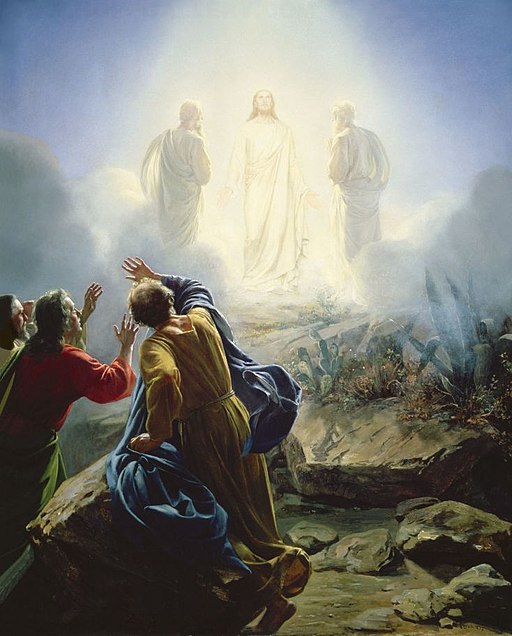
Luke 9:28-36: Moses and Elijah in the Transfiguration of Jesus and beyond
Transfiguration and Resurrection
It was noted in the last blog post that given their positions as the narrative climax at the end of the two halves of Luke’s Gospel, and the tenor of their description, the transfiguration story could be illuminated by the resurrection stories and vice versa. Luke-Acts is renowned for its intra-textual references, particularly parallels between the narrative structure of the books, eg the travel narratives of Jesus and Paul, and among major characters, eg the kind of healings that Jesus did in Luke are reflected in the activities of Peter and Paul. There are four post-resurrection episodes in Luke 24, but it is the first (24:1-12) that is of most significance for understanding Moses and Elijah because of the verbal links to be found between 9:29b-30a and 24:4. When set side by side, they are striking.
9:29b the appearance of his face changed, and his clothes became as bright as a flash of lightning. 30 Two men, Moses and Elijah, appeared in glorious splendor, talking with Jesus.
9:29b τὸ εἶδος τοῦ προσώπου αὐτοῦ ἕτερον καὶ ὁ ἱματισμὸς αὐτοῦ λευκὸς ἐξαστράπτων. 30 καὶ ἰδοὺ ἄνδρες δύο συνελάλουν αὐτῷ,
24:4 While they were wondering about this, suddenly two men in clothes that gleamed like lightning stood beside them.
24:4 καὶ ἐγένετο ἐν τῷ ἀπορεῖσθαι αὐτὰς περὶ τούτου καὶ ἰδοὺ ἄνδρες δύο ἐπέστησαν αὐταῖς ἐν ἐσθῆτι ἀστραπτούσῃ.
The two men, ἄνδρες δύο, in 9:30 are named as Moses and Elijah, but they are unnamed in 24:4. However, it would be difficult to expect Luke’s hearers, listening to the Gospel being read without reference to the other synoptics, to think other than that this is another reference to Moses and Elijah, who, having spoken with Jesus about τὴν ἔξοδον αὐτοῦ, are now here to witness its reality. Nowhere else in his Gospel does Luke use καὶ ἰδοὺ ἄνδρες δύο. He does use καὶ ἰδοὺ ἄνδρες δύο in Acts 1:10. I would argue that all three of these occurrences refer to Moses and Elijah with the twin themes of Exodus and testimony in mind. There is a similar allusive reference in Revelation 11:1-12 carrying echoes not only from the lives of Moses and Elijah, but also of the Ascension story in Acts.
This connection is especially strong because of the suddenness of the appearance of the two men in both cases, indicated by, ‘behold!’ ἰδοὺ.It should be noted that ‘gleamed like lightning,’ ἀστραπτούσῃ, is used of the two men at the scene of the resurrection and a related, but not identical term, ‘bright as a flash of lightning,’ ἐξαστράπτων, is predicated of Jesus at his transfiguration. There appears to be an intentional echo in the language but perhaps, as Siebenthal suggests (Ancient Greek Grammar, Peter Lang: Oxford, 2019, 271, 184h.2), έκ as a prefix can indicate intensity so ἐξαστράπτων used of Jesus reflects a difference in the intensity of the δόξα between them, with Jesus shining more brightly. The transfiguration story does, after all, emphasise Jesus’ superiority and uniqueness. Whatever the difference may be, the sense of Moses and Elijah being in the post-mortem glorious heavenly existence in some embodied way is strengthened by the description of the two men at the tomb. One further point will be made to support this assessment.
A strategy of harmonisation in the synoptic accounts posits that the two in Luke 24:4 are angels. Since both Mark and Matthew mention only one messenger with Mark describing him as νεανίσκον καθήμενον ἐν τοῖς δεξιοῖς περιβεβλημένον στολὴν λευκήν (16:5) and Matthew ἄγγελος, ἦν δὲ ἡ εἰδέα αὐτοῦ ὡς ἀστραπὴ καὶ τὸ ἔνδυμα αὐτοῦ λευκὸν ὡς χιών (28:2f). It is possible, but unlikely, that there were two messengers, as in Luke, and only one is being referred to in Mark and Matthew, but neither Moses nor Elijah would be described as either ‘a young man,’ νεανίσκον, or an angel, ἄγγελος. John’s Gospel mentions two angels (20:12), so no Gospel tells exactly the same story as any other in their details, and a strategy of harmonisation is hard to sustain with any credence.
Given the traditional interpretation of the ‘two men’ in 24:4 (and in Acts 1:10) as angels, it is important to reflect on Luke’s use of the term. He is the NT author most interested in the activities of angels in both volumes of his work, mentioning them almost fifty times. Only in Luke 24:23 are they equated with the ‘men’ of 24:4 and that is in reported speech by those on the Emmaus road, rather than from the perspective of the author himself who refrains from that identification. When Luke as the ‘omniscient narrator’ wishes to denote the presence of an angel of the Lord, he uses ἄγγελος not άνδρός. It is two men at the tomb not two angels and considering the dramatic narrative parallels to the language of the transfiguration it is reasonable to identify them as Moses and Elijah.
Conlusions
Drawing the threads of this study together involves both setting what can be learned about Moses and Elijah as they appear in Luke’s narrative and what may be deduced beyond these conclusions. Bovon (A Commentary on the Gospel of Luke V1: Luke 1:1 – 9:50 Fortress Press: Minneapolis, 2002, 375f, n44) is right in noting that their appearance here is not fully explained and that their presence makes many exegetes uncomfortable, and I believe he is also right as he continues, ‘Luke does not say that these two figures have also been transfigured, but rather that they appear in eschatological glory’, which is fitting for those whose embodiment is one of heavenly existence. The glory of Jesus on the mountain is that of the embodiment of the incarnate son, whose ontological glory cannot be compared with that of those who have received it in the heavenly realm. What is relevant for this thesis is that the appearance of Moses and Elijah on the mount, spoken of as ‘in glory,’ ἐν δόξῃ, is described in terms of a glorious embodiment that has its source in their present heavenly dwelling.

 Steps on The Way