

Last week I fulfilled one of my dreams when we spent five days on the Greek island of Patmos, where the Book of Revelation had its origins. We were part of a McCabe Pilgrimages group where, over the course of ten days or so, strangers became friends.
A couple of years before I retired, I thought about what I would like to share with the congregation on Sunday mornings, especially parts of the Bible that I’d never in the course of my ministry used for a series of reflections. Top of that list was Revelation but given how bizarre a book it is I decided to take several weeks of study leave to engage with it more fully before attempting to preach from it. That proved to be a very good decision! Often preachers pick and choose the bits that are ‘easy,’ like the letters to the seven churches, or the hope of new creation at the end of the book. Getting to grips with the whole book takes a bit more time and effort.
These weeks of study gave me a love for Revelation that I hadn’t experienced before, and a desire to visit the island where ‘John the Theologian’ says he was based ‘because of the word of God and the testimony of Jesus.’ My perception of Patmos was of a very small and remote place, difficult to get to and with a very sparse population. What did I know! Patmos can be reached by a three-hour ferry crossing from Kos, or five hours from Rhodes, and regular international flights from the UK land in these two larger islands. It’s three thousand inhabitants live mainly in the towns of Skala, the port on the narrow isthmus that connects the north part of the island to the south, and Chora, the labyrinthine village that surrounds the monastic fortress on the top of the highest hill of the island.

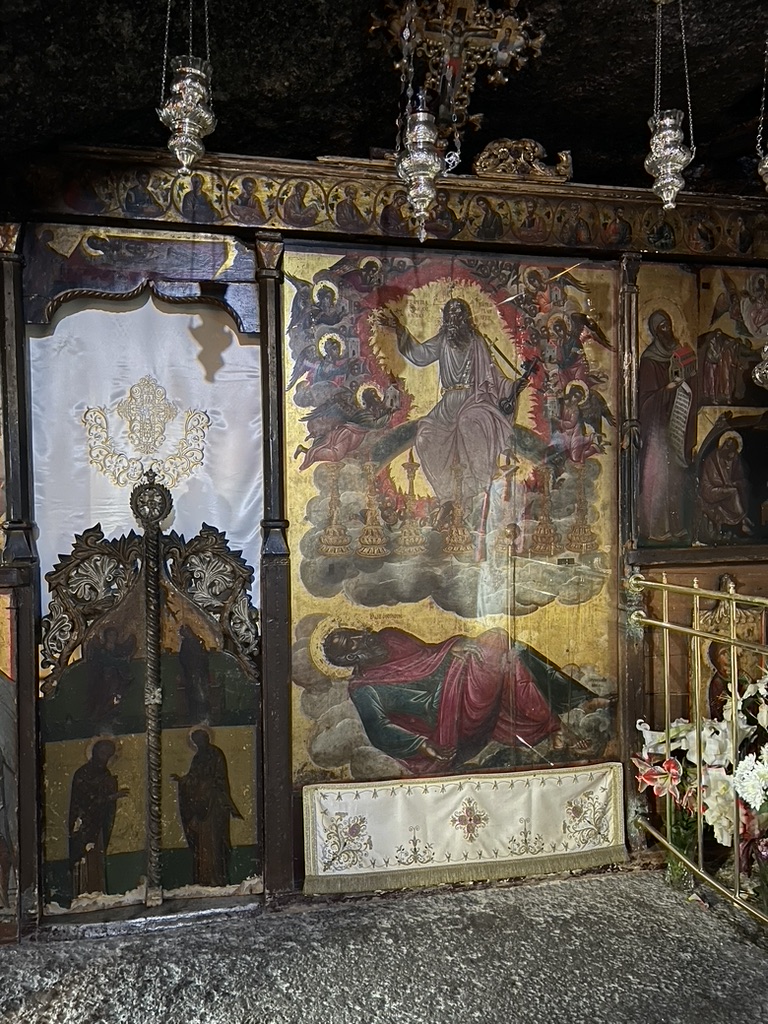
Despite its diminutive size, there is a lot to see both in terms of historical/religious interest and scenery. We had an expert local guide in Antonis Dimas, who spent many years as a travel photographer and writer. Antonis has written his own guidebook, My Own Unknown Patmos. He took us to the cave where John is reputed to have been based during his time on the island, and the monastery founded by Christodoulos in the late eleventh century to keep John’s vision and memory alive on the island, as well as many lovely sites that only a local would know.
In this devoutly Orthodox part of the world, there are many icons on display that remind worshippers of the saints of the past and the crucial elements of the Christian faith. They are an integral part of devotion in the eastern Mediterranean. While these can be widely appreciated, what I connected with most was the sense of isolation that John probably experienced, and how, on a clear day, he could look across the sea towards Asia Minor, modern-day Turkey, to ponder on the groups of Jesus followers to whom he felt compelled to write.
While Revelation may have its roots in some kind of revelatory experience, on close inspection it is clearly a book creatively and carefully written, even if its Greek is the strangest in the whole of the New Testament. It is a mixture of apocalyptic literature, prophecy, and letter, but at its heart is the pastoral desire of ‘John the Theologian’ to help these seven churches, and all Christians, to see the challenges and battles that faced them and how to live faithfully while bearing witness to Jesus.
There was a peacefulness to Patmos that was delightful to experience, and it has already crossed our minds that this would be a good place to revisit.

 Steps on The Way