One of my Open University tutors used to say regularly, ‘Never underestimate the power of serendipity.’ I guess this is such a story. And it is a kind of weird one about me and my love for some Christian songs…in Dutch!
It began pre-pandemic when I came across this, to me, unusual male voice choir on YouTube. They were wearing red striped shirts and funny black hangings around their necks. The singing was good but the amateur recording wasn’t great, so I did a search and came across more such choirs of various sizes and quality. It appears that the uniform is quite widespread among fishing community choirs in the Netherlands.
The choir – more of an ensemble – that I thought were best is one called Soli Deo Gloria Urk, Urk being a picturesque costal town around an hour’s drive NE of Amsterdam. They have recorded albums and videos that I’m still discovering – and, of course, Google Translate is important for me to be able to understand most of the words, but it’s amazing what you can pick up quickly.
It was only later that I discovered that most of the songs I really liked were written by a group called Sela, who specifically took on a task to help renew the worship songs of the church in the Netherlands. (www.sela.nl ). Sela appear to have changed some personnel over the years, but then and now they have produced some very high quality songs and videos, at least some in conjunction with Nederland Zingt (check out their YouTube channel too!).
I can’t count the number of times that Sela songs have proved to be ear worms for me. Every time I think there can’t be another one, I encounter one. ‘Encounter’ is a good word for it, because I have found that these are not simply good songs to listen to, but they have brought me time and time again into the presence of the living God. They have fed, comforted, and inspired. As I write this I’m listening to the one that can be found at the YouTube link below. I was not surprised to see so many people with tears in their eyes, including one of the singers.
But Sela are not out to make as much money as they can from what they produce. Yes, there are things to buy from the website and concerts to go to, but there are so many free resources, like lyrics and simple sheet music. Much to my delight, the one I’m listening to has sheet music with an English translation/adaptation that I hope I can persuade people to use – check it out. ‘I will be there’ or ‘Ik zal er zijn’ based on the name of God revealed to Moses, ‘I am,’ and ‘I will be who I will be’ (= ‘I will be there for you’).
There’s another reason I have been delighted to explore songs in a language that is not my own ‘heart language,’ and that is because I love the picture of the church in the book of Revelation 5:9-10 (NIV) where a song is sung to Jesus: “You are worthy to take the scroll and to open its seals, because you were slain, and with your blood you purchased for God persons from every tribe and language and people and nation. 10 You have made them to be a kingdom and priests to serve our God, and they will reign on the earth.”
The church is a global phenomenon made up of many people and languages, and it’s good to step out of our comfort zone to embrace something of the wider Christian community.
Dive in and explore; listen and be grasped by the hope of the Gospel; be prepared to be touched deep within your being by songs you never imagined you would listen to.
The following is a message I gave at the University of Edinburgh’s Christmas service, held in the magnificent McEwan Hall. It was my last responsibility as an Honorary Chaplain as I retire on 31st December, and a great privilege to substitute for the Chaplain who was unwell.
UE Carol service address 11th December 6pm
Not cosy, but edgy.
Good evening everyone. It’s lovely to be back here in the McEwan Hall to celebrate Christmas together – and no World Cup matches to distract us.
It will come as no surprise to you that, as someone who spent 30 years in parishes conducting Christmas services, I have a few Christmas ‘pet hates’ so, for a moment I’m going to play the Grinch! On that list is receiving Christmas cards with a robin redbreast on the front, and also the way in which the generosity of that ancient follower of Jesus called St Nicholas has been corrupted and commercialised into Santa Claus. Our culture has, effectively, made Christmas cosy.
It is tempting to say, then, that we get rid of these ‘pet hates’ and focus on ‘the real meaning of Christmas’ but when we ask what that is, there are as many answers as there are people asked. In truth, there are many appropriate answers to this question for Christmas is like a precious diamond with many facets. As we carefully examine each facet, looking deeply into the beauty of this diamond, we discover that we not only understand more about this festival, but we are also changed by that understanding.
The facet we look at tonight is found in the Gospel of Luke, from which we have two readings. Luke self-consciously sets his Gospel story in two different contexts: first the Greco-Roman world – we read, ‘In those days, Caesar Augustus issued a decree…’; and second the religious and ethnic traditions of the Jewish people – Mary, Joseph and other characters are devout in their Jewish faith and their hope is shaped by it. Both these contexts are important, and we will see that they point us to the reality that the story of the birth of Jesus is not a cosy one, but an edgy one. The birth of this little boy is interpreted as an event that will have world changing implications. Indeed, it is seen by Luke as the coming of God to bring to reality in the present, the kind of kingdom, or society, that will reflect God’s own desire for human wellbeing and salvation: his shalom.
This is the story of a young girl, Mary, probably in mid-teens, from a backwater village who is unexpectedly pregnant, and not even by her fiancé. She is a nobody from nowhere in danger of being thrown out, for there is social shame and disgrace in her condition. But Joseph sticks by her and her child because they both believe God has said to them that the little boy is going to be someone special. As Mary reflects on what is happening to her, Luke puts a song in her mouth that sets the agenda for his book and the actions of Mary’s son – we call it the Magnificat. God has taken me, a nobody, and made me a somebody – he lifts up the humble and brings down the proud, even rulers from their thrones; he will fill the hungry with good things and send the rich away empty. What Mary sees coming is an upside-down society that is to be ushered in through this child – it is an edgy and uncomfortable message rather than a cosy one.
When her little boy Jesus grows up and becomes an itinerant preacher, he returns to the synagogue in the backwater village of Nazareth where he grew up, and uses a text from the prophet Isaiah, from whom we have also heard tonight: he quotes – the powerful Spirit of God is at work through me to bring good news to the poor, freedom to those in captivity and healing for those who are blind. To a world in which the élite were impossibly wealthy, the economy was built on slavery and those whose abilities were impaired had to beg or die, this was an upside-down message – not cosy, but edgy.
When so many, even within the Christian community, have made Christmas cosy, with ‘gentle Jesus, meek and mild,’ with robins to make us smile and Santa Claus to give us what we want, the story of the first Christmas, and the Christian tradition more broadly, sees Christmas as an edgy and subversive story. It believes that Christmas brings with it the promise that God will bring this upside-down society to completion at some point in the future yet denies that this is only a ‘pie in the sky when you die’ promise, for the beginnings of that society are here already. The question is, how are we contributing to it? How are we living in and seeking to develop peace, ‘shalom’ – that big word describing total human wellbeing.
If we believe in no God, or in a God who is not bothered about the present, only a distant promise of ‘jam tomorrow,’ then a cosy Christmas may satisfy us. But if we believe in the God of Mary and Joseph, the God who sent Jesus that first Christmas, then a cosy Christmas is not one that will satisfy. The Christmas story as presented by Luke challenges us in our wealth, our pride and our complacency – are we the rich and the proud who will be brought down, or the poor and humble who will be lifted up?
We are living in a world that is in many ways like the times of the first Christmas. There are those in poverty because of the oppressive actions of others, either intentionally, through political extremism or militarism, or by the consequences of our actions – think of Ukraine, Iran, and many other places. There are people who are in captivity, some as sex slaves, or clothes production slaves, political prisoners or exiles because of persecution – think of the trafficking of those who promise a good life elsewhere; the many in poorer countries who slave to make articles to service the desires of wealthier countries; those whose religious beliefs have required them to flee persecution.
All these things can be found in the Roman world in the time of Jesus, and the message of the first Christmas included a warning and a challenge to that world and ours. The warning is that those who perpetrate these activities will be brought low in the short or long term. Beware! The challenge is to all of us: are we among those who perpetrate these injustices, or are we among those who seek to make them right – who hold the values of God’s just society, put them into practice and work for their wider adoption?
This year, let us not be satisfied with a cosy Christmas, turned in upon ourselves, only looking for a good time then saving up for next year. There are many worldwide for whom Christmas will not, and cannot, be cosy this year or any year. For them, we need to hear the edgy call of the birth of Jesus to be sharers in working for his upside-down society until the day when it comes to fulfilment. As we examine this facet of the Christmas diamond, let us not only see its beauty; let us allow ourselves to be changed by it. Amen.
Luke 9:28-36: Moses and Elijah in the Transfiguration of Jesus and beyond
Transfiguration and Resurrection
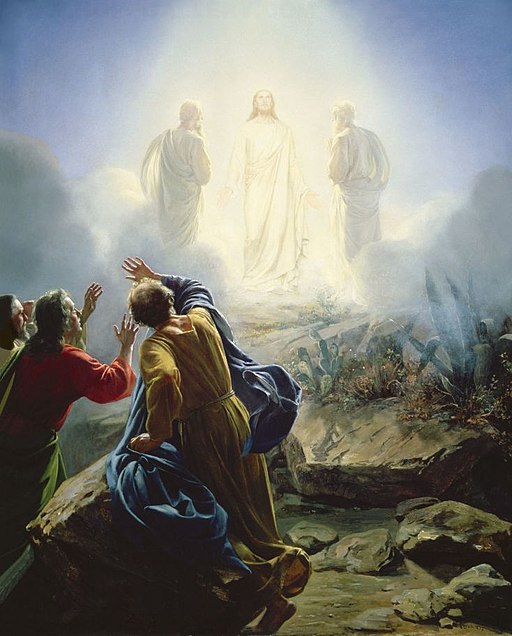
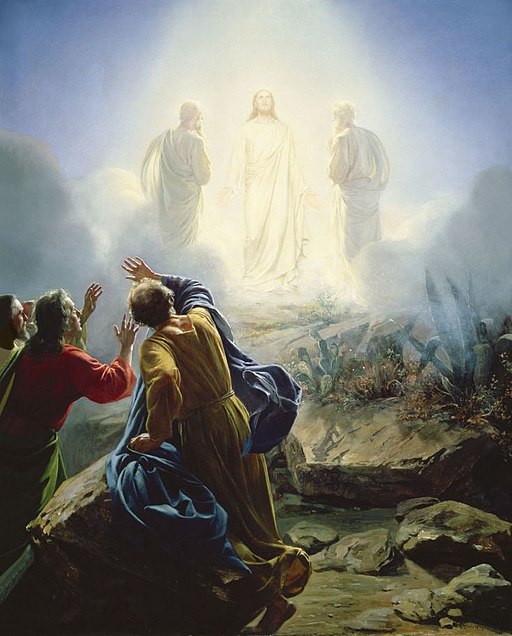
It was noted in the last blog post that given their positions as the narrative climax at the end of the two halves of Luke’s Gospel, and the tenor of their description, the transfiguration story could be illuminated by the resurrection stories and vice versa. Luke-Acts is renowned for its intra-textual references, particularly parallels between the narrative structure of the books, eg the travel narratives of Jesus and Paul, and among major characters, eg the kind of healings that Jesus did in Luke are reflected in the activities of Peter and Paul. There are four post-resurrection episodes in Luke 24, but it is the first (24:1-12) that is of most significance for understanding Moses and Elijah because of the verbal links to be found between 9:29b-30a and 24:4. When set side by side, they are striking.
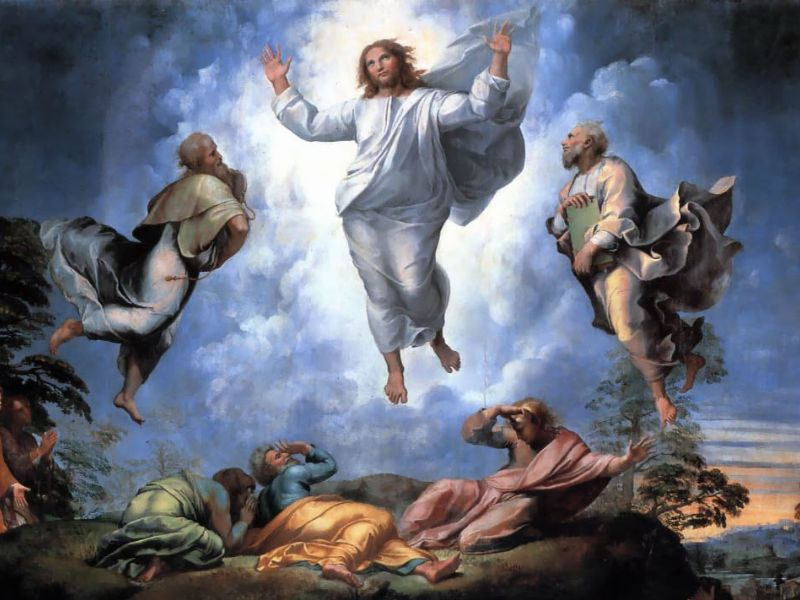
9:29b the appearance of his face changed, and his clothes became as bright as a flash of lightning. 30 Two men, Moses and Elijah, appeared in glorious splendor, talking with Jesus.
The two men, ἄνδρες δύο, in 9:30 are named as Moses and Elijah, but they are unnamed in 24:4. However, it would be difficult to expect Luke’s hearers, listening to the Gospel being read without reference to the other synoptics, to think other than that this is another reference to Moses and Elijah, who, having spoken with Jesus about τὴν ἔξοδον αὐτοῦ, are now here to witness its reality. Nowhere else in his Gospel does Luke use καὶ ἰδοὺ ἄνδρες δύο. He does use καὶ ἰδοὺ ἄνδρες δύο in Acts 1:10. I would argue that all three of these occurrences refer to Moses and Elijah with the twin themes of Exodus and testimony in mind. There is a similar allusive reference in Revelation 11:1-12 carrying echoes not only from the lives of Moses and Elijah, but also of the Ascension story in Acts.
This connection is especially strong because of the suddenness of the appearance of the two men in both cases, indicated by, ‘behold!’ ἰδοὺ.It should be noted that ‘gleamed like lightning,’ ἀστραπτούσῃ, is used of the two men at the scene of the resurrection and a related, but not identical term, ‘bright as a flash of lightning,’ ἐξαστράπτων, is predicated of Jesus at his transfiguration. There appears to be an intentional echo in the language but perhaps, as Siebenthal suggests (Ancient Greek Grammar, Peter Lang: Oxford, 2019, 271, 184h.2), έκ as a prefix can indicate intensity so ἐξαστράπτων used of Jesus reflects a difference in the intensity of the δόξα between them, with Jesus shining more brightly. The transfiguration story does, after all, emphasise Jesus’ superiority and uniqueness. Whatever the difference may be, the sense of Moses and Elijah being in the post-mortem glorious heavenly existence in some embodied way is strengthened by the description of the two men at the tomb. One further point will be made to support this assessment.
A strategy of harmonisation in the synoptic accounts posits that the two in Luke 24:4 are angels. Since both Mark and Matthew mention only one messenger with Mark describing him as νεανίσκον καθήμενον ἐν τοῖς δεξιοῖς περιβεβλημένον στολὴν λευκήν (16:5) and Matthew ἄγγελος, ἦν δὲ ἡ εἰδέα αὐτοῦ ὡς ἀστραπὴ καὶ τὸ ἔνδυμα αὐτοῦ λευκὸν ὡς χιών (28:2f). It is possible, but unlikely, that there were two messengers, as in Luke, and only one is being referred to in Mark and Matthew, but neither Moses nor Elijah would be described as either ‘a young man,’ νεανίσκον, or an angel, ἄγγελος. John’s Gospel mentions two angels (20:12), so no Gospel tells exactly the same story as any other in their details, and a strategy of harmonisation is hard to sustain with any credence.
Given the traditional interpretation of the ‘two men’ in 24:4 (and in Acts 1:10) as angels, it is important to reflect on Luke’s use of the term. He is the NT author most interested in the activities of angels in both volumes of his work, mentioning them almost fifty times. Only in Luke 24:23 are they equated with the ‘men’ of 24:4 and that is in reported speech by those on the Emmaus road, rather than from the perspective of the author himself who refrains from that identification. When Luke as the ‘omniscient narrator’ wishes to denote the presence of an angel of the Lord, he uses ἄγγελος not άνδρός. It is two men at the tomb not two angels and considering the dramatic narrative parallels to the language of the transfiguration it is reasonable to identify them as Moses and Elijah.
Conlusions
Drawing the threads of this study together involves both setting what can be learned about Moses and Elijah as they appear in Luke’s narrative and what may be deduced beyond these conclusions. Bovon (A Commentary on the Gospel of Luke V1: Luke 1:1 – 9:50 Fortress Press: Minneapolis, 2002, 375f, n44) is right in noting that their appearance here is not fully explained and that their presence makes many exegetes uncomfortable, and I believe he is also right as he continues, ‘Luke does not say that these two figures have also been transfigured, but rather that they appear in eschatological glory’, which is fitting for those whose embodiment is one of heavenly existence. The glory of Jesus on the mountain is that of the embodiment of the incarnate son, whose ontological glory cannot be compared with that of those who have received it in the heavenly realm. What is relevant for this thesis is that the appearance of Moses and Elijah on the mount, spoken of as ‘in glory,’ ἐν δόξῃ, is described in terms of a glorious embodiment that has its source in their present heavenly dwelling.
Luke 9:28-36: Moses and Elijah in the Transfiguration of Jesus and beyond
Moses and Elijah
Much has been said about the significance of the two companions seen by the disciples. Who are they, why are they here and what do they tell us? They are identified by Luke as Narrator and the words of Peter as Moses and Elijah, and scholars have explored the links they have with Jesus.
The long-dead Moses and the long-absent Elijah are both closely associated with prayer (Exodus 33:7-11; 1 Kings 18:41-46), a major Lukan theme here; their prophetic actions are associated with mountains, Sinai and Carmel; both experience the dramatic and powerful presence of God on mountain tops, sheltered only by rock (Exodus 33:12-23; 1 Kings 19:9-18); both are intimately linked to the theme of God’s saving action as ἔξοδος, ‘exodus’ (Exodus 12:31-42; 2 Kings 2:8`). I have only come across one commentary (Levine and Witherington, Luke, 262) that asks this first question of two that are rarely asked: how did the disciples know that it was Moses and Elijah? In what state of being did they appear and of what significance for their present state is that appearance? Given what they are remembered for and associated with there is no surprise that Luke says the two companions are Moses and Elijah. But these later stated connections are confirmations by commentators of the significance of their identity based on later reflection, rather than the basis on which Peter could have made his immediate identification. This is true for the listener on first hearing even if it is Luke who put these words into Peter’s mouth. His record of Peter’s words follows the earlier tradition of Mark and the conclusion that the audience is likely to reach is that the identification was calculated on how they looked and were dressed. Luke records in 9:19 that some people were suggesting that Jesus was Elijah, returning to fulfil the eschatological role predicted for the prophet. While Luke does not use the description of Elijah in 2 Kings 1:8, one who wore a camel-hair coat and a leather belt around his waist, as motif in identifying the significance of John the Baptist, the description of Elijah would have been well-enough known to the apostles themselves as they listened to the Prophets being read in the synagogue.
Another story that would point the way for this mode of identification is to be found in 2 Maccabees 15: 7-16, where Maccabeus rouses his troops by sharing a vision of Onias, who had been high priest, praying with outstretched arms. Another man appears beside him in similar pose who is described as εἶθ᾽ οὕτως ἐπιφανῆναι ἄνδρα πολιᾷ καὶ δόξῃ διαφέροντα, θαυμαστὴν δέ τινα καὶ μεγαλοπρεπεστάτην εἶναι τὴν περὶ αὐτὸν ὑπεροχήν, ‘distinguished by his gray hair and dignity (δόξῃ), and of marvellous majesty and authority (NRSV v13).’ He is identified as the prophet Jeremiah, praying for the people he was once commanded not to pray for (Jeremiah 7:16 – note the theme of prayer is common to all these stories). The long-dead Jeremiah is identified by how he looked, taking up a powerfully evocative bodily pose as he prays for the people.
This story is more likely to have been in Matthew’s mind than Luke’s, since Jeremiah is mentioned in Mt 16:14 as a possible identity for Jesus, but it does illustrate from circulating literature how famous people of the past were pictured appearing post-mortem in visions of the present and gives us an inkling of the way in which Jesus’ companions are to be identified. Of major importance to Luke’s way of identifying Moses and Elijah, therefore, is his statement that they were identified by their glory, οἳ ὀφθέντες ἐν δόξῃ ἔλεγον τὴν ἔξοδον αὐτοῦ (9:31). The use of glory, δόξα, is not only an important link to what has been related immediately prior to this incident about the coming of the Son of Man in his glory, ἐν τῇ δόξῃ αὐτοῦ (9:26), but also to the story of Moses. As he meets God on the mountain, Moses experiences the glorification of his face without realising it, Μωυσῆς οὐκ ᾔδει ὅτι δεδόξασται ἡ ὄψις τοῦ χρώματος τοῦ προσώπου αὐτοῦ (Exodus 34:29 LXX), a glory so great that his face must be veiled. Although δόξα is not used of Elijah in the LXX, he does encounter the fiery chariots and horses of Israel as he is removed from earth. It is the two men together who are said to be seen ἐν δόξῃ and so Luke uses δόξα to link Moses, the Son of Man pericope (9:26) and the transfiguration. In doing so he links earthly life embodiment (Moses), eschatological embodiment (Son of Man), and post-mortem embodiment (Moses and Elijah). Describing the state in which Moses and Elijah appeared as ‘post-mortem embodiment’ is a claim that must be justified, and for that the textual description of the men must be examined.
When reading Luke 9:28-36, in order to make sense of the story, it is necessary to picture the two men are as embodied, otherwise it simply does not work. They talk with Jesus, συνελάλουν (9:30), ἔλεγον (9:31). These verbs are both imperfect indicating the ongoing nature of the conversation. They stand with Jesus, τοὺς δύο ἄνδρας τοὺς συνεστῶτας αὐτῷ (9:32). Here the verb is a perfect participle indicating an ongoing state that has been this way for some time. This echoes the use of standing, ἑστηκότων (9:27), as Jesus speaks to those around him, promising that some will not die until they see the Kingdom of God. The posture of those who are alive standing with Jesus is the same as those from beyond this life standing with Jesus on the mount of transfiguration. The only real difference is the communal prefix to the verb. It is as Moses and Elijah make to leave, καὶ ἐγένετο ἐν τῷ διαχωρίζεσθαι αὐτοὺς ἀπ’ αὐτοῦ (9:33), that Peter starts to speak. Presumably they are making to walk away when Peter interrupts their departure. The whole scene is one in which the two men are clearly identified as exercising several bodily actions.
It appears, then, that the two men were identified by how they looked, and that they were in some state of post-mortem glorified embodiment. In the next section we will think of how the story of the resurrection informs the story of the transfiguration.















 Steps on The Way