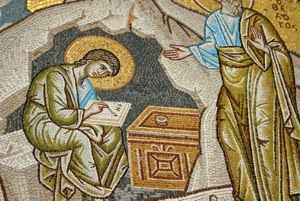
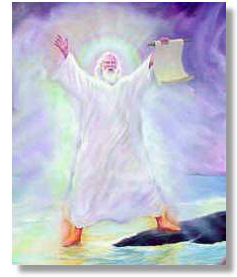
Let all who are thirsty come

Short Address at the Robin Chapel – 26 August 2018

Introduction

Edinburgh is a beautiful city in which to live at any time of the year, but there is a special atmosphere about the place when the Festival is taking place in August. Tens of thousands of people from across the globe come to visit especially for this cultural extravaganza, making it truly a Cosmopolis. Turn a corner in the old town and you never know what you will find. Children are agog at women and men on unicycles, fire-eaters, street theatre and statues that suddenly move.

We have been to a few performances. With other people of a certain age we queued to watch Maureen Lipman, aged 72 (as she complained how she is always referred to in the papers), and, while we were waiting, there were the usual folks trawling for paying customers for their own shows. One girl tried to offer me a leaflet: stand-up comedy, she said. No thanks, I replied, I prefer to have a seat. Instead, we listened to Misha Glenny tell the stories of international crime, which accounts for 15% of global GDP, and we were entertained and inspired at the King’s Theatre, watching a play called ‘Home’ with its portrayal of the phases and faces of a house over the course of its lifetime.

Round the corner from where we live, there is a campsite, which is mainly static caravans, but at this time of year the section that is usually empty fills up with tents of various shapes and sizes and motor homes. For some, the Festival is like a pilgrimage.

As the weeks go bye, there is a sense of mounting excitement in anticipation of the closing concert and firework display – tomorrow evening as it happens. Each year it seems to become more sophisticated and adventurous, with Princes Street and the Gardens jam packed with people, and on the hills across the city others are standing with their binoculars to their eyes and their smartphones blasting out the concert music, out of synch with what they are seeing.

Then the last rockets explode, and as the colour fades from the sky and the smoke and smells dissipate, we turn to go home saying, ‘Well that’s it for another year!’ The highs of excitement become the lows of weariness, and the climax of the final evening gives way to the anti-climax of the following morning. We are left saying, ‘Thank goodness we can get back to normal life for a while,’ and at the same time we are left thirsting for more.
We have been entertained, felt happy, been challenged, made angry, laughed, cried, shared life with strangers, celebrated with friends, and now we only have the memories and feelings.

Jerusalem – the Feast of Tabernacles/tents

While the specifics of festivals in other places and in other times may be very different – like the Notting Hill Carnival in London, or the Feast of Tabernacles/tents in Jerusalem in the time of Jesus – the generalities of festivals are much the same. People flock to them from all over, the city becomes a buzz of excitement for a time, a wide variety of special events take place and then they finish.

Sukkot, the feast of tents or huts we read of in John’s Gospel, is probably the most joyful and fun of the feasts celebrated by those who are of the Jewish faith. In Jesus’ day, groups of people from families and villages travelled together up to Jerusalem, telling their stories, catching up with news, singing their Psalms – the songs of ascents, the ‘going-up’ songs, with their children playing together, then asking if we’re nearly there yet.

And what fun it was for them to live in tents or little hut shelters for a week, remembering what life was like for their ancestors as they journeyed through the desert under God’s protecting pillar of cloud by day and fire by night. Just as Edinburgh’s castle is on a hill that can be seen from near and far, so Jerusalem’s Temple and its courtyard could be seen from a distance and from all across the city. They had their equivalent of our fireworks, with four giant menorahs, or menorot as we should say, which were lit every evening in the temple courtyard and the glow of their light could be seen right across the city, reminding the people of the protecting presence of God with his pilgrim people.

Like George Fredrick Handel, they not only had the fireworks, they had the waterworks! Every day there was a ritual procession as priests walked from the Temple, drew water from the Pool of Siloam and returned to the Temple to pour it out as a libation at the base of the altar, and on the seventh day, they did this seven times, symbolising the vision of Ezekiel the prophet who saw God’s river of the water of life flowing from the temple, and as it flowed on, grew deeper and wider – deep enough to swim in, flowing out bringing life wherever it flowed.

One can imagine the sense of joy and happiness as people watched and joined in this procession, waving their palm branches, singing their Psalms, celebrating God’s actions in the past in the desert, his bounty in the present as grain and grape harvests had just been gather in, and his promises for the future – the vision and hope that God would renew his people and bring them fullness of life.

Jesus at the feast

And then they were getting ready to go home, to return to the humdrum of normality, when Jesus stepped up and started shouting out an invitation: ‘Let anyone who is thirsty come to me and drink. Whoever believes in me, as Scripture has said, rivers of living water will flow from within them.’ John tells us that he was speaking of the Holy Spirit, who would indwell Jesus’ followers.

Jesus was aware that, however exciting, joyful, challenging or pious our festivals are, however much we feel fulfilled by them at the time, ultimately, they pass. They become a distant memory and leave us thirsting for more. This thirsting, the yearning for an experience of what is beyond us, is a signpost to our deep need for God. It was the great Augustine who said that our hearts are restless until they find their rest in God.

Jesus is telling us that it is only through him that this thirst can be slaked, this yearning satisfied. But more than that, he is inviting all Festival goers to come and receive this free gift of God’s water of life – God’s Holy, life-giving, life-enhancing Spirit, living within us.

It is not a life that is free from suffering and sorrow, as Jesus’ experience of the cross and our own experiences of life teach us. But it is a life whose orientation is towards the coming fulness of the Kingdom of God – the New Creation brought about by the life-giving Spirit. This life lives in the present by the power of the future, and that orientation enables us to walk forward on this pilgrim journey in joyful hope.

Conclusion

Reading this passage from the Gospel of John, I can imagine on the last day of this Edinburgh Festival Jesus standing in George Square, or at the Tron Kirk, or on the Ross Bandstand, shouting his invitation, ‘Come to me and drink.’

And in his mysterious book of Revelation, John the Theologian places on the lips of the Risen Christ a renewed invitation that is not only for Festival goers but for all: The Spirit and the Bride say, ‘Come!’ And let the one who hears say, ‘Come!’ Let the one who is thirsty come; and let the one who wishes take the free gift of the water of life.
Amen!
Posted in Uncategorized | Leave a comment

Dear Friends (on WordPress, FaceBook and everywhere else),


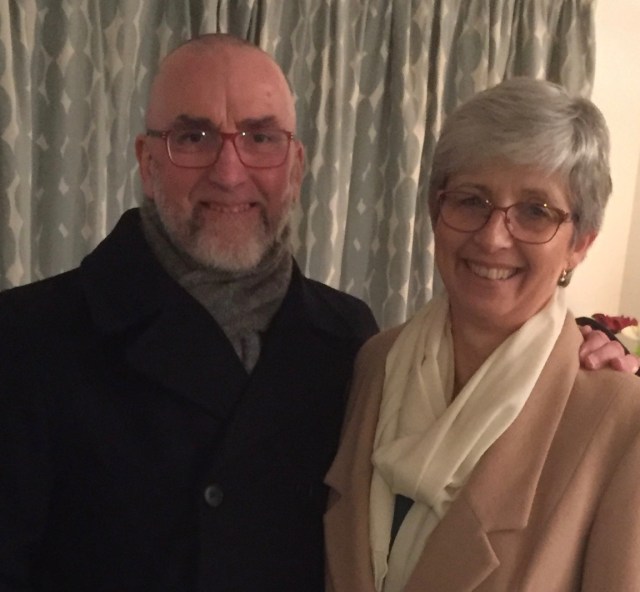
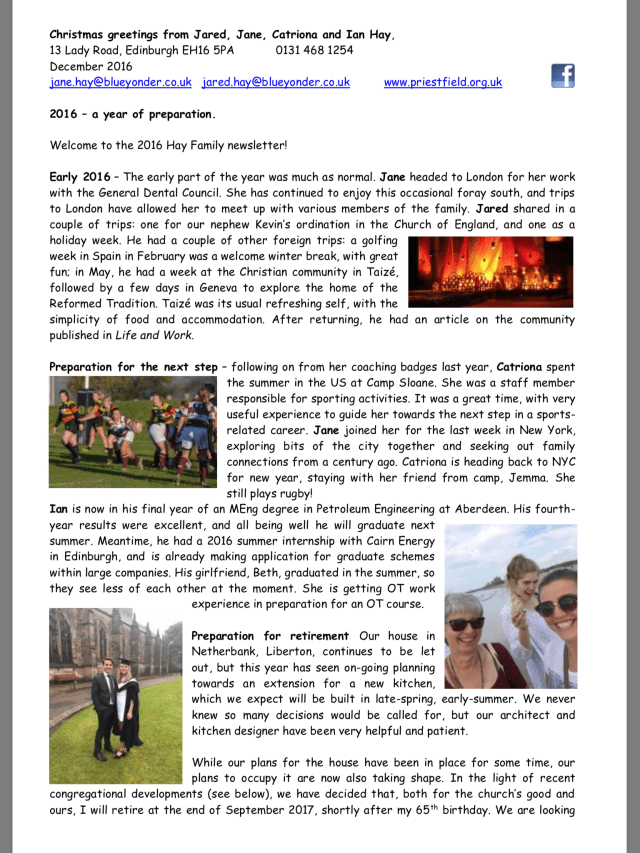
2017 has been an exciting but difficult year for the Hay family, related in our annual Christmas newsletter – link below.


This Christmas is the first that we will spend in our new home (please note our change of address), and the first time in 30 years that Jared has no Christmas service responsibilities.


Our newsletter comes with our best wishes to you for a happy Christmas, and the blessing of God in 2018.


Love,

Jared, Jane, Catriona and Ian.


2017 xmas letter


J&J30.jpg

Posted in Uncategorized | Leave a comment

My ‘Father in Christ’

One of my oldest and dearest friends, Jim McMinn, was laid to rest on Tuesday 2nd May, and it was a great sadness to me that I was unable to be present. However, as a way of remembering him I wrote this reflection on how Jim (and his late wife Avril) helped me on my journey of faith. May he rest in peace and rise in glory.

When the Apostle Paul sought to guide the recalcitrant Christians in Corinth, he reminded them that while they might have many guardians, they only had one ‘father in Christ.’ There are many in my generation and younger who looked upon Jim McMinn as our ‘father in Christ.’ There are lots of adjectives we could use to describe Jim – bright, enthusiastic, funny, mercurial, impulsive, generous, committed, and we could go on. But I just focus on this one: fatherly, and here are some stories that reflect it from my own experience.

A Fatherly homemaker – his fatherliness was not restricted to his own family even in the family home. Many a time – probably too often! – there were invitations to join the family for meals, supper, sing songs (from Sankey’s to Youth Praise by way of the Believer’s Hymnbook). There was always a welcome that said, ‘You are loved; you belong.’ Serious theological discussions took place, about Scripture, the Church and the world, but always amid jokes and laughter, creating a safe place to explore and assess different viewpoints. There were also some crazy events that took place in the home like the Saturday afternoon Jim, Ken Roxburgh and I pushed back the furniture in the lounge for a wrestling match. Jim made a great unfatherly Mick McManus, and Avril’s ill-concealed displeasure meant that it never happened again – thank goodness!

A Fatherly friend – away from the home, there was always fun when we shared a round of golf, or pitch and putt at Craigie on light Thursday nights in May after the Prayer meeting. The score was the least of it, although we did play for such imaginary trophies as the EW Rogers Cup, and the Albert Leckie Memorial Trophy. These were friendly contexts in which we shared the things that were happening in life – triumphs and tragedies – and, whether Jim listened or not, it gave us the sense of being valued and cared for.

A Fatherly mentor – Maybole was a place familiar to Jim long before he and Avril chose to live there. Once a month, at least three of us, Jim, Ken and myself, would attend the Sunday morning service at the Gospel Hall. In such a small group, it’s impossible to be silent. We cut our teeth participating in worship on the long-suffering people of Maybole – and to add to their misery, we would regularly be preaching at their evening meeting too! Jim, mentored us in constructive ways that didn’t damage our longing to be better students and teachers of the Word of God.

A Fatherly taxi driver – although Jim drove occasionally for Merry’s Taxis in Prestwick, that’s not what I mean. For several years, we attended a Brethren Bible Conference in Durham, and Jim drove us there, usually via Douglas where we joined the M74. This meant we had to pass through Murkirk, which we nicknamed The Great Tribulation. He introduced us to the delightful cornering of the Ford Anglia, and the stylish lines of the Vauxhall Viva, among other cars. The family car became a taxi, and even worse, he invited young people, such as we were, to drive it. He showed trust in us that was rare. Just as well he was an insurance broker. But the journeys back were always full of chatter about the mind-opening discussions we had shared with such esteemed scholars as the late Fred Bruce, of whom Jim was a real fan.

Fatherly requests – it is a great sorrow not to be present at this thanksgiving service for Jim. It was my privilege to share in the thanksgiving service for Avril, and to conduct Jim and Molly’s wedding almost five years ago. ‘Don’t wear your dog collar!’ Not only did Jim help prepare us for life and ministry, but like a good father he let us go, sending us out into the wider world to live our lives, and was gracious enough to invite his ‘children’ back to share in events that were significant and precious.

All the stories I’ve shared about my experience of Jim as a fatherly man beyond his own family have, as their focus, what was the central truth of Jim’s life: whether in the home, or at work, or in the Church, Jim was first and foremost a Christian – a person ‘in Christ.’ He was not ashamed of it, nor did he shout it from the hilltops – he just was one, and the whole of life was shaped around that fact. And he did all he could to be a ‘father in Christ’ to others so that they would grow in faith and discipleship. In this aspect of his life, at least, he would be justified in saying, as Paul said to the Corinthians, ‘I urge you to imitate me.’ We’re still trying to do so.

Jared Hay, 27 April 2017.

Posted in Uncategorized | Leave a comment

Christmas Newsletter 2016

img_1505


img_1506

Posted in Uncategorized | Leave a comment

The Great Apostles of Jesus

It’s funny how some things come together at a certain point in time to make you re-imagine an image that you have held for a very long time. At the moment I’m delving into Paul’s letter to the Romans for a series of Sunday studies and Thursday discussions, so am finding out a bit more than usual. I’ve been reading commentaries on Paul’s letters, and on the Acts of the Apostles for decades, and never before have I come across the information that the name Paul is a Latin baby name, and in Latin the meaning of the name Paul is ‘little, small.’ Being born a Roman citizen, he probably had three names in the common Latin format, and that his other name, ‘Saul,’ which we know from Acts, was likely one he took when going to study in Jerusalem.

So that’s one piece of the new image jig-saw. The second is that the latest member of our extended family was born prematurely, and only weighs just over three pounds. We are praying for her and all her loved ones, because she is tiny, being born before her time.

These two pieces of the picture came together and sparked off another memory of a comment that Paul makes about himself and when he became an Apostle: ‘Then [the Risen Jesus] appeared to James, then to all the apostles, and last of all he appeared to me also, as to one untimely born (1 Cor 15:7f).’ ‘Untimely born’! What if Paul was using this metaphor not just because his call to be an Apostle was later than the others, but also because it was actually part of his own experience – that he had been born prematurely, and because he was a tiny baby, was called ‘Paul.’ I’ve never really heard a fully convincing explanation of why Paul chose that metaphor, but it would certainly make sense if this was part of his personal history.

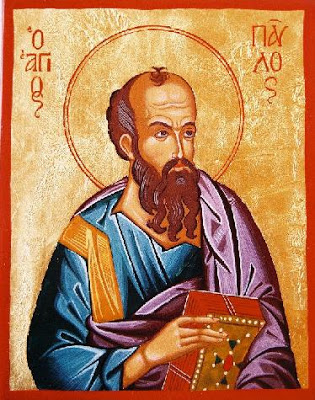
There’s one last piece of this jig-saw, and that is the traditional images of Paul in the icons of the Church. He is always a small man, with reddish, receding hair and a beard. Of course we don’t have photos of him, but these icons of the memories of those who knew him and passed on stories about him may have more than a grain of truth to them.

So there we have it. The great Apostle to the Gentiles: Tiny. A small man who was also a colossus.

Oh, and there’s that other Apostle who was sent mainly to the Jews – Simon, called Peter, which means, Rock, or as the great Biblical commentator, Raymond Brown, called him, ‘Rocky.’


Rocky and Tiny – the great Apostles of Jesus to the Jews and the Gentiles.

PaulIcon

Posted in Uncategorized | Leave a comment

The Place called Skull

This short Good Friday reflection was given at the service in Priestfield Church.

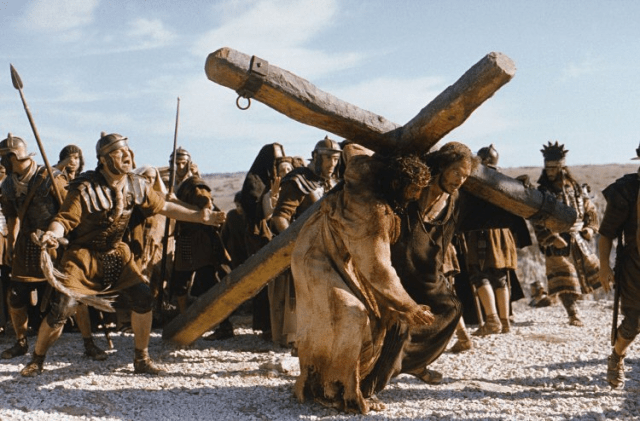
golgotha-02-cyrene-a

We walked through the streets of Newington this morning, a small band of pilgrims carrying a simple cross made of the trunks of two Christmas trees bound together. While we were on this journey from Craigmillar Park to Nicolson Square, the world around us just seemed to be going about its normal business. There were people selling things in shops; in cafés, friends were meeting for coffee and scones; workmen were putting up a new shop frontage.


It occurred to me that this is how it would have been that first Good Friday in Jerusalem. Tens of thousands of people were there for the festival, and the traders would be out selling their wares to all who passed by. The streets would be heaving, barely aware of the little procession passing through as a cadre of Roman soldiers marched a bloodied and beaten man to his execution. They didn’t have far to go, but it took them a while to get there, and he was so weak that they had to commandeer someone to carry the cross beam for him.


And then they arrived at the place. They call it Skull – a piece of gallows humour for this killing ground. It was at Skull they crucified Jesus, and if ever a method of execution was invented for the pleasure of torturing the condemned, it was crucifixion. Men could last for days if they had the strength, and it made it a lot more fun for the crowds. It was also a good warning to those who might have thoughts of crime or revolution in their heads: this is what we Romans do to those who get in our way.


The Place called Skull; the place of crucifixion; the place of greatest paradox and mystery for the Christian faith.


A paradox is holding two things to be true that would seem to conflict. Like, God cannot die; Jesus, the Son of God, died on the cross. How can this be?


A mystery is something that we cannot adequately explain: at Christmas we ponder on the mystery of the incarnation – that in Jesus, God became human. On Good Friday, we ponder on the mystery of Christ’s suffering – that through this violent death of Jesus, God deals with the evil in us and in the world, bringing about our salvation. Ever since that first Good Friday, Christians have sought to explain how that ‘works.’ They used many word pictures, from the court, from the slave market, from the life of the Temple – all of them say something, but none of them can convey it fully, for the way in which Jesus’ death ‘works’ to bring about our salvation is, ultimately, lost in mystery.


This leads us to the fact that there is another paradox at the place called Skull: this experience of darkness and suffering was, for Jesus, a time when he sensed the absence of God – ‘Why have you forsaken me,’ taking upon his lips the words of Psalm 22. Yet in this event of cosmic significance, God has never been more present, dealing with the root causes of suffering and evil, sin and guilt – of all that negates our wellbeing – so that we would experience God’s life and shalom, God’s salvation.


It seems that someone unexpected grasped that something very special was happening at Skull that day – the Roman centurion. One didn’t become a centurion by being squeamish. It was the job of a hardened veteran who had seen many deaths in battle, and who had had to endure the vicious cursing of those being crucified by his troops. But this man Jesus was not like that. In fact, he seemed to take this suffering to himself as if it belonged to him. Even the earth was behaving strangely, with noon feeling more like midnight.


When Jesus breathed his last, surrendering his life with a cry at the top of his voice, this man with hardened experience of soldiering bears witness at the end of Mark’s Gospel to the truth of Mark’s assertion at the beginning of his Gospel by saying, ‘Surely, this man was the Son of God.’


It is this man, the subject of paradox, the centre of mystery, whom we worship as Son of God. It is this man who has, by his suffering and death, effected our salvation – he has borne our sins and carried our sorrows. It is this man we follow, and in following find that we too must take up the cross. But rather than finding only death through the cross, we find life – God’s life of the age to come.

Posted in Uncategorized | Leave a comment

‘Love one another, as I have loved you.’

The following is a brief reflection given on Maundy Thursday 2016 at our local ecumenical early morning service.

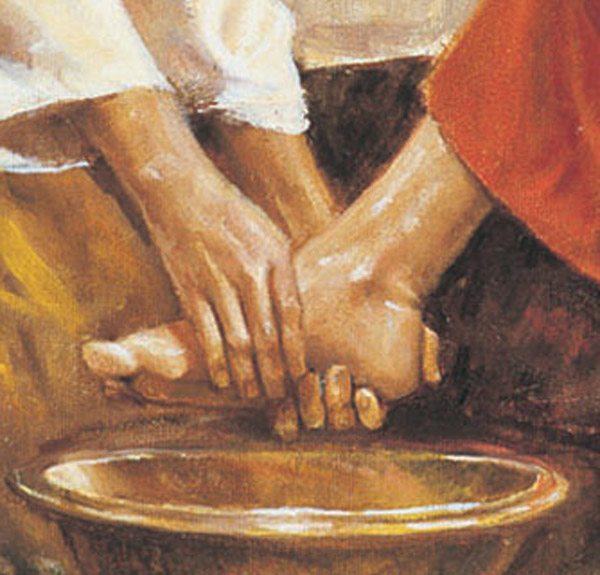
Jesus washing feet

John 13: 31b – 35

31b Jesus said, ‘Now the Son of Man is glorified and God is glorified in him. 32 If God is glorified in him, God will glorify the Son in himself, and will glorify him at once.

33 ‘My children, I will be with you only a little longer. You will look for me, and just as I told the Jews, so I tell you now: where I am going, you cannot come.

34 ‘A new command I give you: love one another. As I have loved you, so you must love one another. 35 By this everyone will know that you are my disciples, if you love one another.’

Message.

Picture the scene at Brussels airport: a family are saying goodbye to a parent. There are hugs and tears, and the parent says, ‘I love you, and remember you be good to each other – I want you to love each other the way I love you.’ The family turn and start to make their way home; the parent goes to the check-in, and all of a sudden there’s an explosion. Death tears the family apart, and the final words the family shared take on a much greater significance than they did when they all expected to meet up again before long. I don’t know if this scenario played out the way I’ve suggested, with exactly the words I used, but it’s likely that something very similar took place when a mother said goodbye to her husband and children.


On that first Maundy Thursday, when Jesus washed the feet of the disciples, he told them to love one another the way he had loved them. They were expecting life to go on much as usual after the Passover festival. It has been an exciting and exhilarating time for them over the last few years – a roller-coaster experience of highs and lows as they accompanied Jesus on his mission to the villages of Galilee, or were sent out in twos to put into practice what they had learned from him, or stood beside him in his conflicts with the religious leaders of the day. That conflict seemed particularly intense this year. And round the Passover table he had said a few confusing things about the bread and wine as his body and blood. It will all blow over soon the way it had before.


But it didn’t. Instead, there was the trauma of Jesus being arrested, taken from them because of the kiss of Judas; then Jesus was tortured, humiliated and crucified. They had thought this was going to be just one more Passover in Jerusalem, but they were wrong, and Jesus was snatched away from them by betrayal and death.


So these words came to mean much more to them than they ever imagined: a command from Jesus, for us to love one another. And not just love one another, but love one another the way I have loved you.


When, Tertullian, the early Church Father from North Africa, imagined the pagan people of his time speaking about Christians, he wrote, ‘See how these Christians love one another.’ For the people of his time seemed to be more interested in plotting against and killing one another. The contrast between pagan and Christian was stark in his society, to the extent that it spoke volumes to those with ears to hear. Could we say the same today without the words being coated with a heavy layer of irony? Too often in the West, Christians have become known for violent rhetoric and political shenanigans. ‘See how these Christians love one another,’ as another Christian bites the dust, torn asunder by the congregational lions. Perhaps I exaggerate, but only just.


If ever there was a time when society needed its Christians to show love, and to show others how to love, it is now. We are encompassed with suspicion and terror; migrants and asylum seekers are being demonised and blamed for many of the ills we have created; political rhetoric is engendering aggression rather than reasoned debate. Society needs its Christians to heed the command of Jesus to love one another. It is a command, not to have a nice warm feeling about other people, but to live out in action the kind of sacrificial love he had for us that led him to the cross.


We will find that in loving one another that we cannot stop with one another. Loving our Christian sisters and brothers will prove a good testing ground for loving those whom our society discards so readily. Our Mission Impossible is to spread Christ’s loving action, but it becomes a Mission Possible through the power of his resurrection and the indwelling of his Pentecostal Spirit.


May it be that the people of our time will be able to look at the Christians in this area and say, ‘See how they love.’ Amen.

Posted in Uncategorized | 1 Comment

Hay Family Newsletter

Apologies to those who have found the family newsletter difficult to download. Here’s a low resolution version which I hope you can read.

2015 xmas letter – low res

Posted in Uncategorized | Leave a comment

Hay Family – 2015 Newsletter

Dear all,

warmest Christmas greetings and all good wishes for 2016!


From

Jared, Jane, Catriona and Ian Hay!

nativity siloutte080


2015 xmas letter

Posted in Uncategorized | 1 Comment

Revelation – a sketchy outline

john - writing scrollRevelation is a book with a complex structure that has as many outlines as it has commentators. So here’s mine, using the theme of ‘Scroll’ to indicate of the unfolding story.

1:1-8 Prologue, greetings, doxology

John’s Scroll (the whole book)

1:9 – 3: 22 Instruction to write on a scroll; letters to Churches.

John is instructed to write on a scroll what he sees and send it to the seven Churches in Asia. He records specific messages from Jesus to each of them.

papyrus-sealed-with-seven-seals_1246685_inlGod’s Scroll

4:1 – 5:14 In the worship of heaven, God’s Scroll is introduced

6:1 – 11:18 Preparation for what is in God’s Scroll: it is unsealed with accompanying cycles of disaster, each cycle telling the same story of sin, judgement, lack of repentance in spite of the witness of the Church. Each cycle concludes with ‘the end’ seen as the victory of God and his people in the worship of heaven.

mighty angel10:1-11 A mighty angel displays God’s Scroll opened, and gives to John to eat that he might declare its contents. (Note this comes before the cycles are complete.)

11:19 – 22:17 The Story of God’s Scroll is told: God’s salvation (seen as a new Exodus) and opposition to it (seen in the form of ‘Babylon’ which is a symbol of Rome). Despite the opportunity through the ‘plagues’ (as in Egypt), there is no repentance as the ‘Evil Empire’ continues to oppose the Kingdom of God. The armies of heaven, led by the Lamb, defeat the armies of the Beast. The Empire opposing God collapses, its city is destroyed and the city of God, the New Jerusalem, comes down from heaven to earth – creation is renewed as the permanent dwelling place of God and his people, like an ultimate ‘Eden.’

22:18-21 Epilogue: God’s Scroll and John’s Scroll conclude with warnings and promises.

Jared Hay, September 2015.

Posted in Uncategorized | Leave a comment