The Story of the Scroll(s)

papyrus-sealed-with-seven-seals_1246685_inlStarting out on the journey of reading Revelation, one is struck by how orderly things are to begin with: John is told to write to seven Churches and then we are given these letters to read; he is called up to the Throne Room of God and witnesses the slaughtered Lamb receiving a scroll with seven seals (we are immediately alerted to the numerical repetition) and then we are told what happens when the Lamb removes each numbered seal – that is, until we reach the sixth seal, and that’s where things become more complicated. Before the seventh seal is broken, other important events take place, and the succeeding visions seem to part of what happens as a result of breaking this seventh seal. The following series of seven trumpets is also interrupted, but the last series, of seven plagues, is told as one uninterrupted vision. Are these indications of an original, simpler, document that has been edited, or is Revelation actually a unity that has a more complicated structure than might at first appear?


One of the ways in which to test these theses is to examine the narrative structure of the book to see how the different parts fit together, and how they move the story forward. This should, at least, give an idea of whether or not it could be conceived of as a unity. Although a good editor might be able to achieve a document where we can’t see ‘the join,’ in Revelation ‘the joins’ are so obvious and intrusive that we must wonder if the material was intended to be there in the first place.

For the purposes of this exercise I’m using two books that identify themselves as ‘narrative commentaries.’

James L. Resseguie, The Revelation of John: A Narrative Commentary, Grand Rapids: Baker, 2009.

David L. Barr, Tales of the End: A Narrative Commentary on the Book of Revelation, Salem: Polebridge Press, 2012 (2nd ed).

Barr especially is very helpful in understanding the nature of how literature works, and, in particular, how this difficult literature works.

Posted in Uncategorized | Leave a comment

The Lord’s Day

This is the first Sunday of my Study Leave – perhaps this is the first day when things will feel really different for me, because rather than leading the people of God in their worship, I will be in the congregation being led by others.

It seems to have been during Sunday worship that John had this kind of transcendental spiritual event (like Isaiah): an overwhelming and revelatory experience of the presence of God.

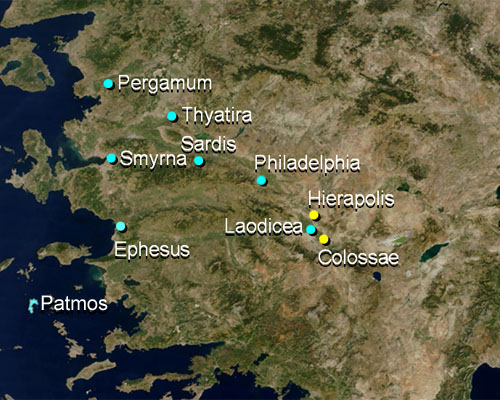
sevenCitiesMap‘I, John, your brother and companion in the suffering and kingdom and patient endurance that are ours in Jesus, was on the island of Patmos because of the word of God and the testimony of Jesus. 10 On the Lord’s Day I was in the Spirit, and I heard behind me a loud voice like a trumpet, 11 which said: ‘Write on a scroll what you see and send it to the seven churches: to Ephesus, Smyrna, Pergamum, Thyatira, Sardis, Philadelphia and Laodicea’’ (Rev 1:9-11).

When John is invited to enter the throne room of God, his words stretch to breaking point in order to describe the glory and majesty of the one who sits on the throne and lives for ever and ever. But it is there, with representatives of all creation, and with those who led the people of God (Twelve Tribes and Twelve Apostles), that John hears the songs that offer the worship that the one sitting on the throne is worthy of. It is to God we owe our existence and by whom we were created (whatever the mechanism used); it is to God we owe our worship because he is our Creator.

Now, I need to go to join with the Lord’s People on the Lord’s Day to give to the Lord God the worship that belongs to God and God alone.

Posted in Uncategorized | Leave a comment

Followers of the Slaughtered Lamb – the deaths in Charleston

There’s no doubt that we see, and interpret, the reality around us differently according to what is uppermost in our own experience at the time. I well remember the effect that conducting the funeral of a stillborn child had on me shortly after our own first child was born.

Now engaged in the study of Revelation, it was through this lens that I saw the tragic killing of nine black Christians at a prayer and Bible study group in Charleston, S.C. They were shot by a white supremacist, now in custody. Along with the usual debate about guns in US society (he was given a gun as a 21st birthday present), there is the revulsion that such a thing would happen in a place made holy by prayer, as people were praying.

Events like this are not new, however. In my lifetime we have seen the martyrdom of Óscar Romero, Janani Luwum, Jerzy Popiełuszko and Dorothy Stang, who are only illustrative of the many women and men from across the continents whose lives have been taken because of their faith and defending the marginalised.

Such martyrdom is, in fact, a major part of the narrative of Revelation, written to Churches in Asia who had known the loss of some of their own, and who are warned that they will face great persecution in the near future. While the term ‘martyr,’ or ‘witness,’ had not yet taken on the idea of giving one’s life as a witness, it was because of the increasing frequency of its occurrence that it did so.

‘When he opened the fifth seal, I saw under the altar the souls of those who had been slain because of the word of God and the testimony they had maintained. 10 They called out in a loud voice, ‘How long, Sovereign Lord, holy and true, until you judge the inhabitants of the earth and avenge our blood?’ 11 Then each of them was given a white robe, and they were told to wait a little longer, until the full number of their fellow servants, their brothers and sisters, were killed just as they had been’ (Rev 6:9-11).

bound_lamb_3-300x179Who opens the seals of this scroll? It is the one John sees standing as a lamb having been slaughtered – Jesus. It was by his slaughtering (we tend to sanitise such words to make it less graphic in our minds, but we need to be sensitive to the bloody nature of the death) that he triumphed, and his followers will share in that victory. But in the meantime, they also share in his suffering. Being followers of the slaughtered Lamb they have experienced the same painful, bloody, messy death.

While part of John’s intention is to forewarn his listeners (the book was written to be heard) of what is to come their way, he also seeks to give them comfort and hope. Yes, the martyrs must wait for the slaughtered Lamb to bring them justice, but they will not need to wait for ever. In the meantime, they are rewarded with garments purified by his blood – there could hardly be a more dramatic oxymoronic metaphor than laundered white in blood. But in the end, they, together with the slaughtered Lamb, will triumph. Not by responding violently to the violence they have experienced, but through the suffering of the great tribulations they have experienced.

13 Then one of the elders asked me, ‘These in white robes – who are they, and where did they come from?’

14 I answered, ‘Sir, you know.’

And he said, ‘These are they who have come out of the great tribulation; they have washed their robes and made them white in the blood of the Lamb. 15 Therefore,

‘they are before the throne of God
and serve him day and night in his temple;
and he who sits on the throne
will shelter them with his presence.
16 “Never again will they hunger;
never again will they thirst.
The sun will not beat down on them,”[a]
nor any scorching heat.
17 For the Lamb at the centre of the throne
will be their shepherd;
“he will lead them to springs of living water.”
“And God will wipe away every tear from their eyes” (Rev 7:13-17).

May the visions of Revelation help our suffering sisters and brothers in Charleston interpret their present reality, and also bring them comfort and hope.

Posted in Uncategorized | Leave a comment

Pulling back the curtains

curtainsThe last time I was at the theatre I saw, ‘Pressure,’ a play about the Scots weather-man who persuaded Ike to wait 24 hours to launch D-Day, thus ensuring its success. It was funny, poignant and dramatic, revealing ‘behind the scenes’ events of the greatest sea-borne invasion the world has ever known. But it could have been a disaster because of the weather. A day’s delay gave them an open door for a few hours, and through that door they entered continental Europe to bring deliverance. The events on which the play was based had taken place seventy years before, and doubtless the dialogue was an imaginative reconstruction of conversations that might have taken place, stitching the whole narrative together.

When we take our seats to wait for a play to begin, the stage curtains are closed. As they are drawn back, we are invited into a different world from the one in which we are living; we are being given a new interpretation of reality to consider. ‘Apocalypse’ is the word that was used to convey this sense of revelation – it is the unveiling of something previously hidden to us.

Reading the Book of Revelation is a bit like going to the theatre. John the Seer is drawing back the curtains on the great story of the world and its destiny. He is opening a door for us to enter into the story, and give us a new perspective on the reality around us – sometimes a very strange way of seeing it, but a way that takes us to the heart of what it means.

As we open the pages of his book, the curtains are drawing back. He invites us to step out of our reality and into his so that we might, at the end, have a deeper understanding of the reality in which we are living, and where it is heading.

Posted in Uncategorized | Leave a comment

A White Stone with a New Name

Some years ago I had the privilege of conducting the wedding of two lovely young people and my wife and I were invited to the wedding banquet. This was held out in the country in a stable block that had been converted into a venue for holding large events.

We searched for our names on the seating plan and then sought out our places – how would I know which seat was mine? There, on the table, lay a stone with my name on it – I had been given a place at the table for the wedding banquet and this was proof that I had the right to be present.

The ever-living Christ, who walks among the lamps of the churches, writes to the church in Thyatira:

Whoever has ears, let them hear what the Spirit says to the churches. To the one who is victorious, I will give some of the hidden manna. I will also give that person a white stone with a new name written on it, known only to the one who receives it. (Revelation 2:17)

IMG_1395Every time I read this passage I think of my stone, with my name on it. Stones were sometimes used as invitations, and white stones to indicate a verdict of acquittal. To his faithful people, the ‘overcomers,’ Christ, the bridegroom, gives a place at the table to celebrate his marriage supper. The white stone, assuring of God’s verdict of being ‘righteous,’ is my invitation because it has my new name on it.

Posted in Uncategorized | Leave a comment

When you speak of Christ, you speak of God

blog picSometimes in the fast flow of the impressionistic visions John relates conversations take place. Often this is with a character described in ways that it is obvious John is reaching for words in human language that will convey the glory and majesty of this character – but he can never fully describe this so he often uses the word ‘like.’

When we stop to ask, ‘Whom is John describing? Is it God or is it Christ?’ we are immediately drawn into one of the main elements of John’s theological and pastoral purpose. That we have to ask the question at all means that the descriptions John gives are similar. Indeed, some of them are used of both God and Christ. So, for John, when you encounter Christ you encounter God; when Christ says something, it is God speaking; when Christ does something, it is the action of God. In creation, redemption and the dispensing of justice, Christ is the agent of God and is worthy to receive the worship that belongs to God alone.

Posted in Uncategorized | Leave a comment

Worship, Witness, Winning – Apocalypse Now

I am only moments into my Study Leave, and already I’m becoming immersed in the text and the ethos of the book.

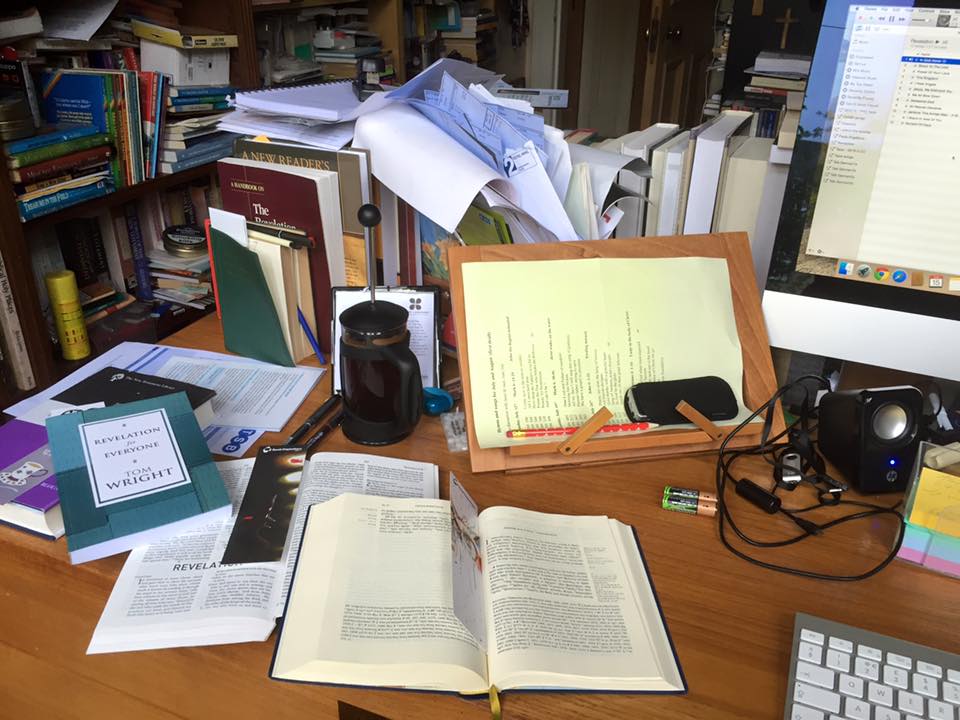
In an attempt to link the academic study of this enigmatic text with its ultimate spiritual purpose of shaping who we are, I’m using Tom Wright’s Revelation for Everyone together with the Common English Bible (not the translation I normally use) and the Greek text of NA28 for morning personal devotions. But in the background I have also put together a playlist of songs that take up themes of the book and express them in music and song. Oh, and a mug of coffee to sharpen the mind.

The immediate impact on me of this juxtaposition is the realisation that three major themes of the book stand together: worship, witness and winning. We cannot do other than bow down before the one who speaks with a loud voice and whose eyes are flaming fire, because he was, is and is coming. The dramatic and impressionistic descriptions of Revelation are to provoke worship, and they do.

The ‘John’ who has these visions is already bearing witness of Jesus (not sure if this is an objective or subjective genitive, but no matter) and inspiring steadfastness in testifying, despite present and predicted suffering at the hands of the Evil Empire, is another part of John’s purpose. If you worship and witness for Jesus, you are most likely to suffer for your faith, perhaps even die.

But in the end, the Evil Empire will not win. Instead, it is the King of Kings and Lord of Lords who will win. Longsuffering faith will be vindicated, justice will be dispensed and those who have suffered for their testimony will be honoured, every tear being wiped from every eye. Amid threats and persecution, John brings to us a word of hope, the hope of the victory of the Slain Lamb.

My immediate response to this book is, ‘This is for me in my time,’ and my prayer is that I will be able to covey to others that it is also for them in their time.

Basic playlist:

In God Alone

I Hear Angels

We All Bow Down

Awesome God

Jenkins: God Shall Wipe Away All Tears

Posted in Uncategorized | Leave a comment

A time for war and a time for peace

In my first charge, Newbattle, we marked the 50th anniversary of VE Day with members of the Royal Army Medical Corps, leading the congregation and community in thanksgiving for deliverance from an evil that threatened the whole world 
As a family, we walked the Normandy beaches shortly after the 60th anniversary of D-Day, and were deeply moved by things that we saw and heard. Exploring the American cemetery near Omaha beach (& watching Saving Private Ryan) were powerful experiences that left us grateful for the sacrifices made by countless young women and men who gave their lives for our freedoms. The Nazi philosophy threatened the freedom of all and destroyed a continent. 
However, on the point of going to Germany to celebrate the wedding of two wonderful young friends, I am now conscious of a generation who are not responsible for the sins of their forebears and who do all they can to forge friendships across cultures and national barriers. While it is important for all of us to be aware of the history behind today’s VE Day commemoration, they (& their national leaders) should not constantly have to experience the discomfort of the UK’s near obsession with such commemorations. Let us rather build bridges of friendship that are more likely to make future conflicts less likely.

Posted in Uncategorized | Leave a comment

‘Father, into your hands I commend my spirit.’

Good Friday reflection on the last of the Seven Words from the Cross – St Peter’s Lutton Place.

Father, into your hands – Luke 23:44 – 46

44 It was now about noon, and darkness came over the whole land until three in the afternoon, 45 for the sun stopped shining. And the curtain of the temple was torn in two.46 Jesus called out with a loud voice, ‘Father, into your hands I commit my spirit.’ When he had said this, he breathed his last.

Amen, and thanks be to God for his word.

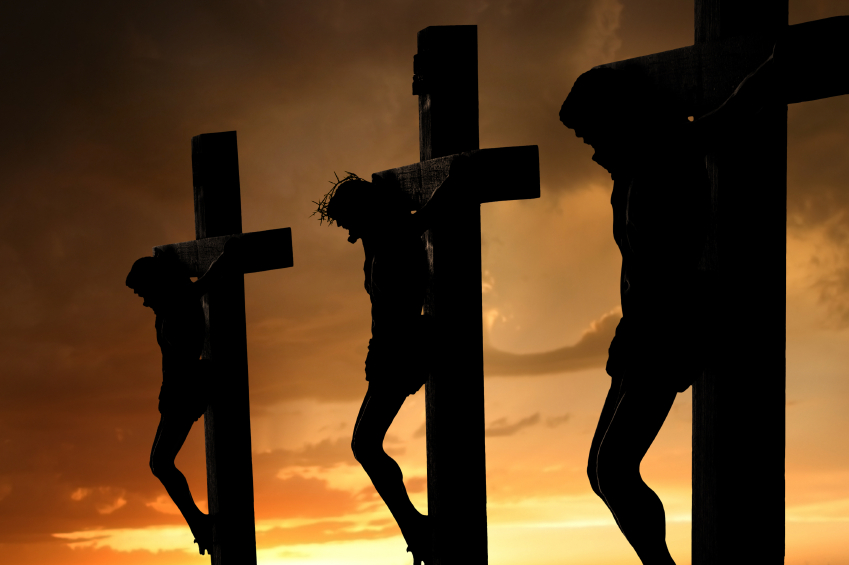
crucifixion-silhouetteTwice I have been present when people have taken their first breath, but although I have seen a number of lifeless bodies, I have never been present when they have taken their last breath. This time last year my mother-in-law died, and although I was among the family members by her bedside for most of the time, her last breath was taken when only her two daughters were with her. They said it was very peaceful, and for some it is so. For others, there is a struggle to keep hold of life, not wanting to let it go; or a struggle to let each breath be the last in order to be free of the pain.

Throughout his ministry, Jesus had a sense of destiny: he could not die until it was the right time – his hour had not yet come. But now, this was his hour. This was the time when he would be lifted up and the glory of God would be present amid the darkness and shame of his crucifixion. Among the remarkable things about the death of Jesus is the fact that he had the strength remaining to cry in a loud voice, and that this final cry is not like the earlier one with its sense of dereliction, ‘My God, my God, why have you forsaken me?’ In these hours of pain and suffering, Jesus comes to terms with what is happening and brings his mission of salvation and liberation to its climax. As he does so, his life is not taken from him, he entrusts it to his Father in heaven.

In Greek, the word for wind, breath and spirit is the same word – Pneuma, from which we get English words like pneumatic. With his last breath, Jesus entrusts his whole being into the hands of his loving Father. It was God who breathed into Adam the breath of life, and he became a living being; it is God who receives the breath of life from the Second Adam, but receives it in order to restore it on the day of Easter resurrection. There is this great sense of trust, so that Jesus places his life and breath into the faithful hands of his Father.

Across the world today, there are many followers of Jesus who are having to say to themselves, ‘do I fight back against persecution, or do I entrust my spirit to my heavenly Father?’ Hundreds, even thousands of our brothers and sisters are surrendering their lives rather than renounce their faith in Christ. As they draw their last breath, they entrust themselves into the hands of their Father, who will restore that life on the great day of resurrection.

We too, in our day to day existence must ask ourselves, into whose hands do we place our last breath? Whatever the future may hold for us, let us be assured that the safest hands for our last breath are the hands of the one who made us. As Jesus did, in faith and hope we entrust our spirits to the one who gave them, knowing he will restore them on the day of resurrection. Friday is here, but Sunday is coming.

Posted in Uncategorized | Leave a comment

Holy Week 2015 – Wednesday: And it was night

John 13:21-32

21 After he had said this, Jesus was troubled in spirit and testified, ‘Very truly I tell you, one of you is going to betray me.’

22 His disciples stared at one another, at a loss to know which of them he meant. 23 One of them, the disciple whom Jesus loved, was reclining next to him. 24 Simon Peter motioned to this disciple and said, ‘Ask him which one he means.’

25 Leaning back against Jesus, he asked him, ‘Lord, who is it?’

26 Jesus answered, ‘It is the one to whom I will give this piece of bread when I have dipped it in the dish.’ Then, dipping the piece of bread, he gave it to Judas, the son of Simon Iscariot. 27 As soon as Judas took the bread, Satan entered into him.

So Jesus told him, ‘What you are about to do, do quickly.’ 28 But no one at the meal understood why Jesus said this to him. 29 Since Judas had charge of the money, some thought Jesus was telling him to buy what was needed for the festival, or to give something to the poor. 30 As soon as Judas had taken the bread, he went out. And it was night.

31 When he was gone, Jesus said, ‘Now the Son of Man is glorified and God is glorified in him. 32 If God is glorified in him,[c] God will glorify the Son in himself, and will glorify him at once.


And it was nightstatic1.squarespace
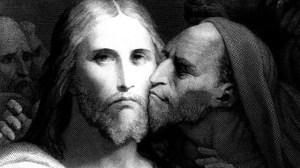
Why did he do it? What got into him? In hindsight, maybe we should have seen it coming – remember, we did notice little things that at the time seemed nothing, but when you add them all together, they explain a lot.


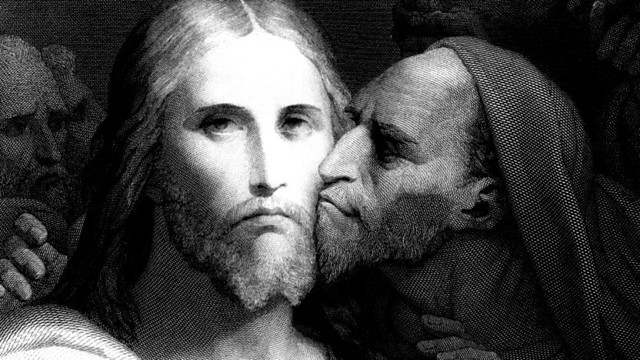
We could be thinking of the Germanwings plane crash, but we’re not – rather, we’re thinking about another betrayal: that of Judas and his betrayal of Jesus. Various explanations have been put forward to explain the motivation of Judas: perhaps he wanted to force Jesus’ hand so that the Kingdom of God would come in its fullness now; or that Jesus would be cornered into overthrowing the Romans in order to save himself; or perhaps it was the money – those thirty pieces of silver he received for planting a kiss on the cheek of his friend, after all, he kept the common purse and we know he was pilfering.


The truth is, we do not know what his motivation was, only that he did it and regretted it, and his remorse was so great that he took his own life. We do, however, know that one being betrayed could see it coming. Jesus, who could see into the souls of those disturbed in spirit, saw into the soul of Judas. The body language, the silence, the avoiding of eye contact, the change of behaviour – something was going on that Judas could not hide and when Jesus handed him the bread, he knew he had been rumbled. The darkness of the night around them enveloped Judas and penetrated every part of his being as he stepped out of the house to go and fulfil his side of the bargain.


The tragedy of this story should not be lost on us as we reflect on the journey of Jesus to the cross and resurrection: it was one of his own who was instrumental in Jesus’ arrest, and the way events unfolded, that arrest would lead to the pain and humiliation of crucifixion. This was truly betrayal.


There are two particular things that I find interesting about this situation, and they speak powerfully to us today. The first is that when Jesus said to the group of disciples that one of them would betray him, they didn’t know whom he meant, and each of them appears to be worried that it would be him – the Synoptic Gospels have the disciples asking Jesus, ‘Is it I?’ Not only had they not seen the signs in the life of Judas, there was a disturbing awareness within all that they might have it in them to betray Jesus. This is sobering for us in our time. If the Apostles felt it possible that they could betray Jesus, then perhaps we need to look to ourselves. Our betrayal cannot be a kiss on his cheek, but a myriad of other possibilities surrounds us as ways not only of denying Jesus as Peter did, but betraying him as Judas did.


The second is that whatever motivation Judas had in betraying Jesus (and we should not immediately leap to the conclusion that it was malevolent), once he had done the deed, he had no control over the consequences. He might have wanted Jesus to fight back, but Jesus didn’t; he might have wanted God to send the armies of angels to intervene, but God didn’t; he might have wanted the arrest of Jesus to be a rallying point of insurrection among the people, but it wasn’t; he might have thought that the thirty silver coins would feel good in his hands, but they didn’t. Once Judas had betrayed Jesus, events took their own course. As many a spy has found out, even what may be seen as justified betrayal can lead to unanticipated catastrophic consequences. Judas was no exception.


However, what was an evil deed in human terms was, in the providence of God, used to bring glory to God and God’s Son. John regularly uses the term ‘glory’ to interpret the crucifixion – Jesus will be ‘lifted up’ upon the cross in both humiliation and glory. Humiliation we can understand humanly, but in viewing the cross from the perspective of God, it becomes the brightest revelation of God’s love in Christ, and shines with the glory of God’s presence. The darkness of betrayal has, unexpectedly, led to the revelation of God’s glory.

Posted in Christology, Discipleship, Easter | Leave a comment