Graduation Reflection – 2 July 2013 11am

This morning I had the privilege of delivering the Moment of Reflection at the beginning of the Graduation Ceremony – and it was a joy to see one or two folks I know walking across the stage to receive their degrees. The text is printed below.
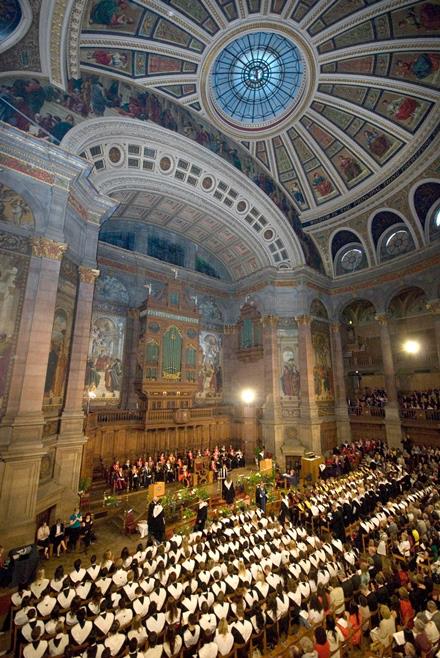
 

mcewan hallGood morning! I expect some of you will know the old joke about two behavioural psychologists who met on the street one day: one said to the other, ‘You feel fine, how do I feel?’ I have no training in psychology, but looking at you today in your graduation robes, I’d say that you look and feel more than fine, and so you should. I congratulate you on your achievements and am sure that your family and friends will be justly proud of you.


A month ago, my wife and I spent a week with the Christian monastic community in Taizé, France. There were around 1500 people present, the vast majority of whom were under 30. All of us came with our questions about life. We made new friends from a variety of countries. One of them, an elderly Dutchman, said to my wife in his heavily accented English, ‘I think your husband looks like a famous film star. His first name is Dustin.’ Personally, I don’t see the resemblance, and I don’t know what he was so chirpy about, because we all agreed that he looked like an aging Sean Connery!


In the moments of silence and times of reflection at Taizé, I not only realised that I am not Dustin Hoffman, but also that I am not the person I was when I first graduated in 1979, or even of ten years ago. I have grown and changed, and my understanding of my vocation has also evolved in that time.


As you look back on the years of study leading to this day, you came to Edinburgh to explore your chosen subject. That exploration has also involved finding out more about yourself and what you want to do with your life – finding your vocation. You are not the same person who started off on that journey of exploration, and you will continue to change and grow.


In the coming years, I encourage you to take time out for reflection on the questions, ‘Who am I now? What is my vocation now?’ Don’t ask them every five minutes, but make the opportunity to listen to your heart and your dreams. As you seek the answers for that point in your life, I hope that you will learn more about yourself and your vocation. I also hope that in finding these answers you will be better able to make your contribution to the common good of humanity and experience a sense of fulfilment in doing so. I wish everything good for you for the years to come.

Posted in Uncategorized | 1 Comment

Match Win, Match Fine

I love watching international rugby, and even some Heineken Cup club rugby on TV, but I have no great liking for the culture that surrounds the game. However, since our daughter Catriona took up playing the game seriously at Lancaster University there’s one particular feature of the LUWRUFC culture that we not only like, we would like to see it adopted by churches. They call it ‘Match Win, Match Fine.’

It goes like this: at the end of the match, regardless of how it has gone, they meet in the bar. Nothing new there then! But after a bit of chat and banter they start with one player and in turn they go round the whole group, even those who didn’t play. Everyone has the opportunity to say something about each player – they call a good thing ‘Match Win’ and a not so good thing ‘Match Fine’ and preface their comments by saying ‘Match Win/Fine.’

After their last home match of the season, Jane and I had the honour of sharing in one of these sessions courtesy of a donation of Krispy Kreme doughnuts. We were so moved by the obvious sense of care and mutual support as time after time appreciative things were said. The ‘Match Fine’ comments were usually said to raise a laugh. I was glad to have the opportunity to give a bit of encouragement to the whole group, because for many of them the camaraderie has been an important element in surviving the difficult times of student life. ‘The world is not like this,’ is how I started. People don’t tell you how good you are or say what they appreciate about your contribution, so keep this up, even when you leave student life.

It wasn’t a long ‘speech’ but it said something I felt it was important to say to express our thanks for their part in our family life, and to give them some memory of an older person saying, ‘This is a great thing to do. Keep it up.’ I could see one or two sets of eyes welling up with tears as I spoke, and I was thankful that what I was saying seemed to be getting home.

A sense of belonging to a loving community with people actually saying good things to your face is something we all need in life. So often in church life there is a lack of community and appreciation, but I’m glad to say that at Priestfield I sense it is getting deeper with an increasing sense of hospitality. But we still have a way to go to be as good as LUWRUFC.

20130402-220441.jpg

Posted in Culture, Family, God | Leave a comment

The Mystery of the Rolling Stone

No, this is not a post about Mick Jagger, but an attempt to answer the question, ‘Why do Christians eat chocolate Easter eggs?’ (Apart from just saying, ‘We like chocolate, so why not?’)

Easter eggs should be eaten on Easter Day and not before, so for the beginning of our answer we need to rewind a little to the Friday before Easter – the day Christians call Good Friday. Jesus has been popular with the common people for his teaching (that God loves them too) and his healing. But he has fallen foul of the religious and political authorities and they conspire to kill him by the horrifically painful method of execution called crucifixion.

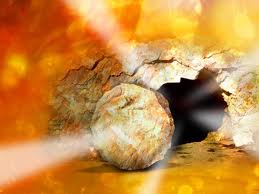
Taking their lives in their hands, two of Jesus’ less well-known disciples, Joseph of Arimathea and Nicodemus, go to Pilate, the Roman Prefect, and ask for Jesus’ body so that they can bury it before the Sabbath, when no work can be done. But where to put it quickly and securely? Joseph is a man who thinks ahead and already has his own grave marked out – a cave with a large stone next to it, which will block the entrance and deter grave robbers. Since it’s near the place where Jesus was crucified they decide to put him there in the meantime and with some effort manage to roll the stone in front of the cave.

Along with the stone there is an official ‘seal’ (a kind of Roman police cordon – ‘do not break this seal on pain of death’) and a guard of soldiers preventing Jesus’ disciples stealing his body to fool people into thinking he’s still alive.

tomb stoneTime passes. Friday afternoon turns into Saturday, and as Sunday dawns, some of Jesus’ female disciples want to get on quickly with the burial rites before he starts to decompose. Before dawn, fumbling their way in through the darkness, they make their way to the cave. To their consternation, confusion and distress, they come to the grave where they think Jesus should be, but there are no soldiers, the stone has been rolled away from the entrance, there is no body and yet there are grave clothes lying folded inside. What the…? Have we come to the wrong place? No… this is the right place so what’s happening?

Christians believe that Jesus was raised to new life and promises a share in that new life to all who follow him. The empty cave is not a proof but a witness to the fact that Jesus is alive. And the stone was rolled away to let us hear the testimony of the empty cave.

That such a big stone was rolled way (in darkness) was said to be the work of angels. Today we make it easier for ourselves! Admittedly we need to use a bit of imagination for this, but each Easter Christians use hard-boiled eggs and chocolate eggs to symbolise the stone that was rolled away from the empty cave – not to let Jesus out but to show it was empty. Our rolling eggs trigger the memories of the story, or re-enact the story, and the fun we have doing it reflects our joy that Jesus is alive.

IMG_0364So tomorrow, Easter Day, roll your eggs, eat your eggs and rejoice that the one who was dead is alive for evermore and offers his life to all.

But why chocolate eggs? Well, we like chocolate, don’t we…and dairy produce is off the menu in Lent!

Posted in Uncategorized | Leave a comment

Good Friday – It is Finished

An early look at my reflection for Good Friday Vigil at St Peter’s Lutton Place – Words from the Cross: It is finished.

It is Finished – John 19:30

28 Later, knowing that all was now completed, and so that the Scripture would be fulfilled, Jesus said, “I am thirsty.” 29 A jar of wine vinegar was there, so they soaked a sponge in it, put the sponge on a stalk of the hyssop plant, and lifted it to Jesus’ lips. 30 When he had received the drink, Jesus said, “It is finished.” With that, he bowed his head and gave up his spirit.

Amen, and thanks be to God for his word.

The more I read of the Gospel of John (and we are reflecting on in just now in Priestfield) the more impressed I am with the carefulness of the author’s language. From the profound theology about the Logos of God in the Prologue, to the details of narrative, words are there because they were chosen to be there in order to fulfill a particular communicative purpose.

Having said that, we all read texts from particular perspectives so that sometimes we hear one word more loudly than another. That’s how this text has been for me this year. I came to it having heightened my awareness of a plant – a herb that I now have growing in my garden: hyssop.

OLYMPUS DIGITAL CAMERAIn Psalm 51, David says, ‘Cleanse me with hyssop and I shall be clean; wash me and I shall be whiter than snow.’ I read this and then asked myself a question I had never, ever asked myself before: why hyssop? What is so special about hyssop, and why should it be used in this kind of confessional context? I did a bit of online investigation to discover that the herb has anti-viral and purgative properties – so you have to be careful about the strength of the infusions you make! It seemed to me that David may be looking to be clean both inside and out.

But there was something else. A glance of its use elsewhere in Scripture is instructive. When the Israelites were about to experience the deliverance of the Exodus, it was with hyssop that the blood of the Passover Lamb was to be marked on the doorpost and lintel of their homes. And in the wilderness, when the sacrificial system was being set up, it was with hyssop that sacrificial blood and water was sprinkled upon people and things in need of cleansing. It is a plant whose name resonates with symbolic meaning because of its use.

And so, when the author of the Fourth Gospel tells us about Jesus being thirsty and being offered wine on a sponge, he chooses his word carefully. It is not ‘a stick’ as all the other Gospel writers say, but ‘a stick of hyssop.’ I believe that the implication he wants us to draw from this is that here upon this Roman cross, the One who is the Word made flesh is becoming our Passover Lamb; is being made our sacrifice for sin; is being made the instrument of our cleansing. Then Jesus says, ‘It is finished.’ The sacrifice is complete, the new Exodus has begun, and we have been washed clean.

In the silence now, reflect on how John wants us to understand what Jesus finished.

Posted in Christology, Easter, nature | Leave a comment

The contractors get ready

The scene in the garden at Priestfield Church today after the snow fell, showing off the blue of the contractor’s huts as they get ready to start work on 11 March. The projected time for the work is 14 weeks, so we should receive the site back in mid-June.

20130224-194618.jpg

Posted in Uncategorized | 2 Comments

‘…and what shall the robin do then…?

Those who know me well, know just how much I hate receiving a Christmas card with a robin on it. (Or a snowman, or a Santa, but the robin just seems to epitomise this for me.) Christmas is about Christ, not winter.

But I’m sharing this to show you that I don’t have it in for robins, because today I was ‘wonderstruck’ – the name of a new book by Margaret Feinberg, who is virtually pestering us to look at things with more wonder. The trouble is that the more people tell you to look with wonder, the less wonder I have. For me, wonder just happens – I can’t make it happen just by thinking about it.

Today it just happened. Without warning. I was sitting having breakfast and I glanced out the window. There it was. A little robin with its red breast proudly sticking out was perching on top of our gate post. For some reason I was entranced by its beauty. Statuesque is how it looked, but with such grace and vibrant colour that no statue of a robin could ever capture.

I realised – slowly, I confess – that it was lying in wait to compete with some sparrows who were munching on some bugs in the pile of apple tree branches stacked ready for collection. Its moment never came. A passing pedestrian scared it from its perch and the branches are gone now too. But for a fleeting moment, there on the gate post it looked as if it owned the world. I was wonderstruck.

20130216-093137.jpg

Posted in Uncategorized | Leave a comment

Darkness and Death; Colour and Life

While it seems no time since Christmas, we are already in Lent, and in order to have Easter cards ready for distribution to the Parish at the right time, they have just been ordered from the printer. That has meant getting the brain into fast-forward to draft an Easter message while trying to keep the heart in Lent, still early on in the journey to the cross. 

The process was helped by recently reading sections of Tom Wright’s book, ‘How God Became King,’ in which he reflects on how Cross and Kingdom relate to each other, including the clash of God’s Kingdom with Caesar’s Empire. The brief message is below together with the picture from the front of the card. If you are the praying kind, pray that it will be used to speak to those who see and read. Thanks. 


IMG_0364Our fluffy bunnies, chocolate eggs and the bright colours of Spring flowers on display seem a million miles away from that first Easter weekend two thousand years ago. The darkness of midnight descended upon Jerusalem at mid-day on Friday, shrouding the suffering of the three men hanging in agony upon Roman crosses. The forces of Empire and Religion had joined together to do away with the Pretender to Israel’s throne – the one they call Jesus, who hung upon that central cross. Might appeared to have triumphed over right.

Yet, in that darkness something mysterious was happening. Christians believe that on this cross, Jesus was taking to himself the evil, suffering and sin of the world – and by doing so brought about the restoration of our relationship with God. But how can we think that this is so? Because death could not conquer Life;  darkness could not extinguish Light. On the Third Day, the first Easter Sunday, the Crucified One became the Risen One. God’s King had triumphed over Caesar and all the forces of Evil. Jesus was alive, and lives for evermore.

Perhaps, after all, the bright colours of Spring flowers will help us celebrate the victory of Jesus over death – as a symbol of the new life he offers to us today.

Jared Hay (Minister)

Posted in Uncategorized | Leave a comment

Ash Wednesday Reflection

The PDF file attached is the reflection for our Ash Wednesday service at 9pm in Priestfield Church Hall.

021313 Ash Wednesday

Posted in Uncategorized | Leave a comment

Ash Wednesday – 13 February

20130209-225946.jpg

Posted in Uncategorized | Leave a comment

This is Friday – but Sunday’s coming

empty tombOn Friday 8 February I will conduct the funeral service of a friend whose life was cruelly taken from him. His own circumstances made his violent death more horrific and unjust.

I wrote a short reflection based on John 11 that I hope will speak to our sense of injustice and pain, but that will also recognise and value the questions his death raises for our relationship with God. I have taken his name out of the text and replaced it with N…

The Gospel According to John – chapter 11, verses 17 – 27

17 On his arrival, Jesus found that Lazarus had already been in the tomb for four days. 18 Now Bethany was less than two miles from Jerusalem, 19 and many Jews had come to Martha and Mary to comfort them in the loss of their brother. 20 When Martha heard that Jesus was coming, she went out to meet him, but Mary stayed at home.

21 ‘Lord,’ Martha said to Jesus, ‘if you had been here, my brother would not have died. 22 But I know that even now God will give you whatever you ask.’

23 Jesus said to her, ‘Your brother will rise again.’

24 Martha answered, ‘I know he will rise again in the resurrection at the last day.’

25 Jesus said to her, ‘I am the resurrection and the life. The one who believes in me will live, even though they die; 26 and whoever lives by believing in me will never die. Do you believe this?’

27 ‘Yes, Lord,’ she replied, ‘I believe that you are the Messiah, the Son of God, who is to come into the world.’

This is Friday, but Sunday is coming.

In the minds of many who have been so deeply affected by the circumstances of N…’s death, there are questions that pose themselves with a keenness that wounds us. Of course, there is the question, ‘Why?’ Why did this happen at all; why did it happen to N…; why is there such evil in the world? And we could add to that list. But just as pressing is the question, ‘where?’ Where were you, God, when this was happening? It is by no means the first or last time this question will be raised. Sometimes it is raised in perplexity, sometimes in anger.

Within the story from John 11, where the good friends of Jesus, Martha and Mary, have lost their brother Lazarus, this question is raised by implication by each of the sisters – we heard Martha’s version. ‘If you had been here, my brother would not have died.’ In other words, ‘Where were you when we really needed you, Jesus?’ There is perplexity and anger amid the sorrow.

However, the story is not over, though we will leave it for a moment. We fast forward in the life of Jesus to Good Friday: he has been arrested, suffered an unjust trial, and has been condemned to death by crucifixion. Hanging in agony upon the cross he takes the words of Psalm 22 upon his lips and cries out, ‘My God, my God, why have you forsaken me?’ In the most desolate and painful experience of his life, Jesus feels a sense of abandonment by God. He knows how Martha and Mary felt, and to a much deeper extent – but the story is not over.

In John 11, it was not long before Martha and Mary knew the joy of having their brother returned to them by Jesus, who says, ‘I am the resurrection and the life.’ Lazarus was, however, alive to die again. But the story is still not over, for the Jesus who felt abandoned on the cross was, himself, raised to life on the third day, Sunday – a different kind of life; the life of God’s new creation – and he promises that through his conquering of death, his resurrection life will be shared by others.

Today, we feel like Martha and Mary asking, ‘Where were you, Jesus?’ The pain of the senselessness and futility of N…’s death is overwhelming. It will take us all our powers to say ourselves that the story is not over. This is Friday, the day of death and sorrow, but Sunday, the day of resurrection, is coming. And while we wait in hope and expectation, we know that there is one in the immediate presence of God who knows how we feel, for once upon a cross he asked, ‘Where are you God?’

Posted in Christology, Easter, God | Leave a comment