
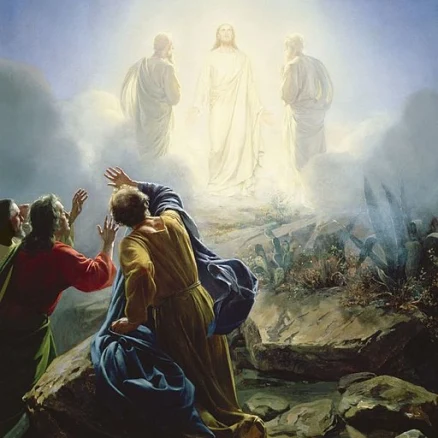
Luke 9:28-36: Moses and Elijah in the Transfiguration of Jesus and beyond
Moses and Elijah
Much has been said about the significance of the two companions seen by the disciples. Who are they, why are they here and what do they tell us? They are identified by Luke as Narrator and the words of Peter as Moses and Elijah, and scholars have explored the links they have with Jesus.
The long-dead Moses and the long-absent Elijah are both closely associated with prayer (Exodus 33:7-11; 1 Kings 18:41-46), a major Lukan theme here; their prophetic actions are associated with mountains, Sinai and Carmel; both experience the dramatic and powerful presence of God on mountain tops, sheltered only by rock (Exodus 33:12-23; 1 Kings 19:9-18); both are intimately linked to the theme of God’s saving action as ἔξοδος, ‘exodus’ (Exodus 12:31-42; 2 Kings 2:8`). I have only come across one commentary (Levine and Witherington, Luke, 262) that asks this first question of two that are rarely asked: how did the disciples know that it was Moses and Elijah? In what state of being did they appear and of what significance for their present state is that appearance? Given what they are remembered for and associated with there is no surprise that Luke says the two companions are Moses and Elijah. But these later stated connections are confirmations by commentators of the significance of their identity based on later reflection, rather than the basis on which Peter could have made his immediate identification. This is true for the listener on first hearing even if it is Luke who put these words into Peter’s mouth. His record of Peter’s words follows the earlier tradition of Mark and the conclusion that the audience is likely to reach is that the identification was calculated on how they looked and were dressed. Luke records in 9:19 that some people were suggesting that Jesus was Elijah, returning to fulfil the eschatological role predicted for the prophet. While Luke does not use the description of Elijah in 2 Kings 1:8, one who wore a camel-hair coat and a leather belt around his waist, as motif in identifying the significance of John the Baptist, the description of Elijah would have been well-enough known to the apostles themselves as they listened to the Prophets being read in the synagogue.
Another story that would point the way for this mode of identification is to be found in 2 Maccabees 15: 7-16, where Maccabeus rouses his troops by sharing a vision of Onias, who had been high priest, praying with outstretched arms. Another man appears beside him in similar pose who is described as εἶθ᾽ οὕτως ἐπιφανῆναι ἄνδρα πολιᾷ καὶ δόξῃ διαφέροντα, θαυμαστὴν δέ τινα καὶ μεγαλοπρεπεστάτην εἶναι τὴν περὶ αὐτὸν ὑπεροχήν, ‘distinguished by his gray hair and dignity (δόξῃ), and of marvellous majesty and authority (NRSV v13).’ He is identified as the prophet Jeremiah, praying for the people he was once commanded not to pray for (Jeremiah 7:16 – note the theme of prayer is common to all these stories). The long-dead Jeremiah is identified by how he looked, taking up a powerfully evocative bodily pose as he prays for the people.
This story is more likely to have been in Matthew’s mind than Luke’s, since Jeremiah is mentioned in Mt 16:14 as a possible identity for Jesus, but it does illustrate from circulating literature how famous people of the past were pictured appearing post-mortem in visions of the present and gives us an inkling of the way in which Jesus’ companions are to be identified. Of major importance to Luke’s way of identifying Moses and Elijah, therefore, is his statement that they were identified by their glory, οἳ ὀφθέντες ἐν δόξῃ ἔλεγον τὴν ἔξοδον αὐτοῦ (9:31). The use of glory, δόξα, is not only an important link to what has been related immediately prior to this incident about the coming of the Son of Man in his glory, ἐν τῇ δόξῃ αὐτοῦ (9:26), but also to the story of Moses. As he meets God on the mountain, Moses experiences the glorification of his face without realising it, Μωυσῆς οὐκ ᾔδει ὅτι δεδόξασται ἡ ὄψις τοῦ χρώματος τοῦ προσώπου αὐτοῦ (Exodus 34:29 LXX), a glory so great that his face must be veiled. Although δόξα is not used of Elijah in the LXX, he does encounter the fiery chariots and horses of Israel as he is removed from earth. It is the two men together who are said to be seen ἐν δόξῃ and so Luke uses δόξα to link Moses, the Son of Man pericope (9:26) and the transfiguration. In doing so he links earthly life embodiment (Moses), eschatological embodiment (Son of Man), and post-mortem embodiment (Moses and Elijah). Describing the state in which Moses and Elijah appeared as ‘post-mortem embodiment’ is a claim that must be justified, and for that the textual description of the men must be examined.
When reading Luke 9:28-36, in order to make sense of the story, it is necessary to picture the two men are as embodied, otherwise it simply does not work. They talk with Jesus, συνελάλουν (9:30), ἔλεγον (9:31). These verbs are both imperfect indicating the ongoing nature of the conversation. They stand with Jesus, τοὺς δύο ἄνδρας τοὺς συνεστῶτας αὐτῷ (9:32). Here the verb is a perfect participle indicating an ongoing state that has been this way for some time. This echoes the use of standing, ἑστηκότων (9:27), as Jesus speaks to those around him, promising that some will not die until they see the Kingdom of God. The posture of those who are alive standing with Jesus is the same as those from beyond this life standing with Jesus on the mount of transfiguration. The only real difference is the communal prefix to the verb. It is as Moses and Elijah make to leave, καὶ ἐγένετο ἐν τῷ διαχωρίζεσθαι αὐτοὺς ἀπ’ αὐτοῦ (9:33), that Peter starts to speak. Presumably they are making to walk away when Peter interrupts their departure. The whole scene is one in which the two men are clearly identified as exercising several bodily actions.
It appears, then, that the two men were identified by how they looked, and that they were in some state of post-mortem glorified embodiment. In the next section we will think of how the story of the resurrection informs the story of the transfiguration.

 Steps on The Way